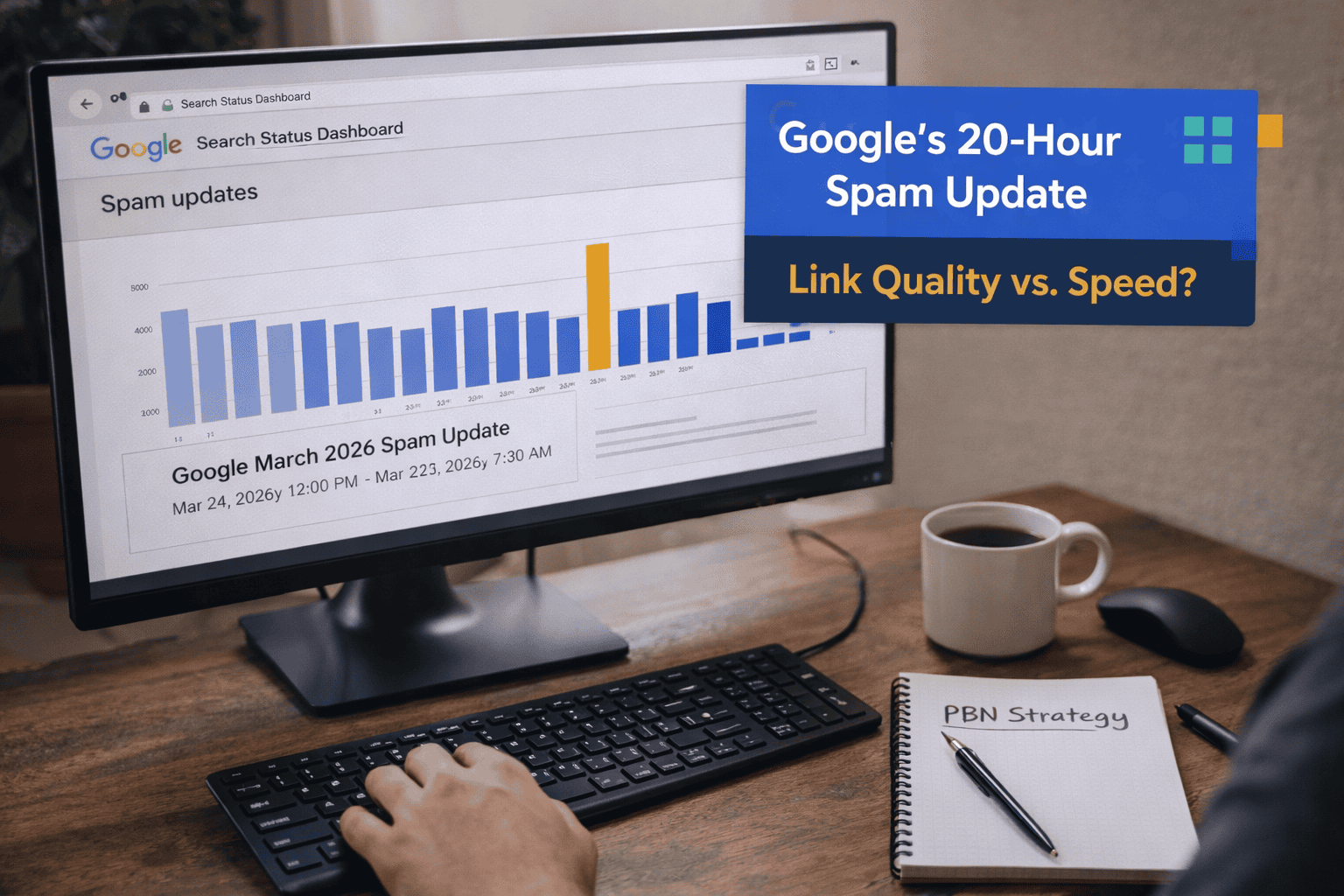
Google just rolled out its fastest spam update yet, finishing in under 20 hours. That’s a sharp break from the multi-week updates we’ve seen before. It points to a shift in how Google handles link spam, faster, tighter, and far less forgiving.
Our review of the March 2026 update, along with recent industry data, shows one thing clearly: low-quality links lose value almost immediately now. That shift also changes how people define the best PBN provider, since speed and quality control now matter more than ever.
THREE SURPRISING FINDINGS:
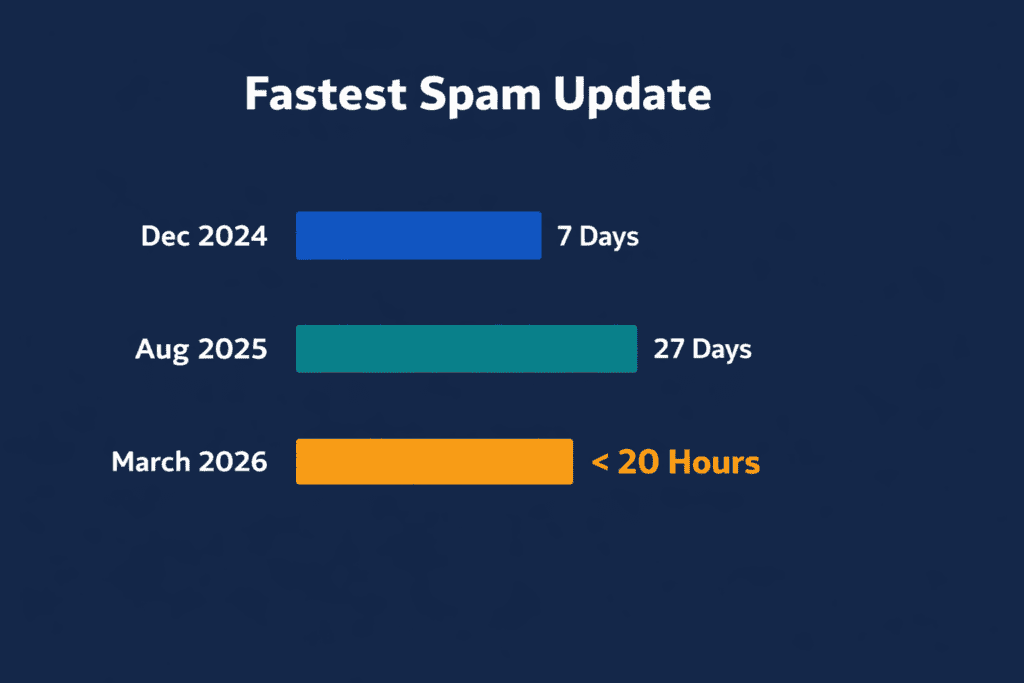
The Speed of Enforcement is Unprecedented: Google’s March 2026 spam update wrapped up in under 20 hours. The December 2024 update took 7 days, and August 2025 stretched close to 27 days. This pace suggests an automated system that can spot and devalue bad link patterns almost in real time.
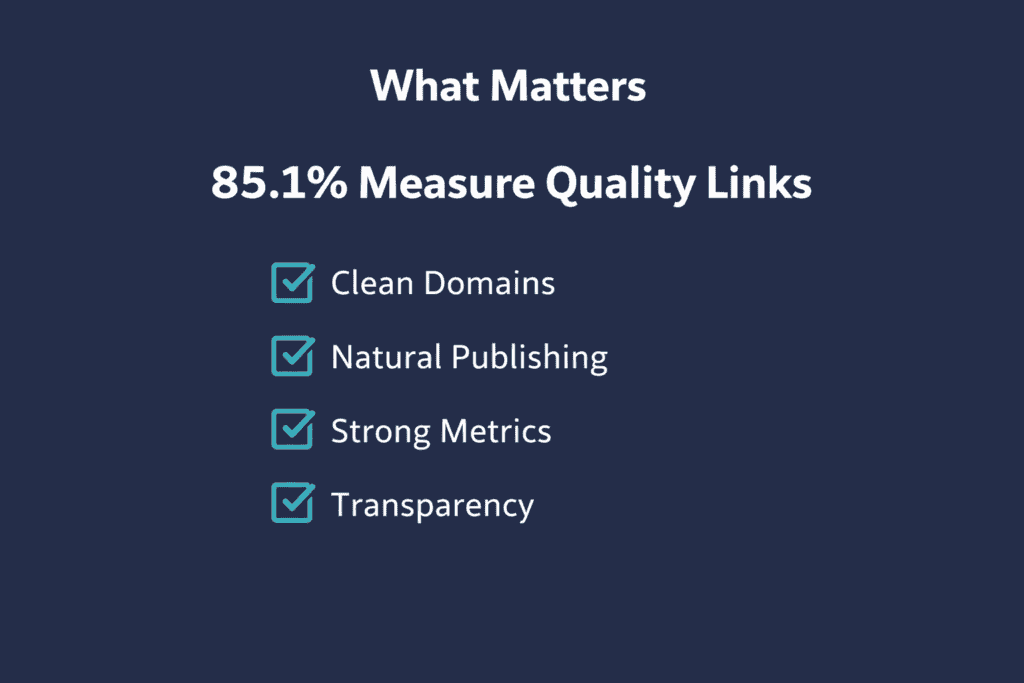
Backlinks Still Drive Digital PR: Even with stricter spam control, 85.8% of digital PR professionals say backlinks are their most effective tactic. Another 85.1% track success mainly by the number of quality links earned. The goal hasn’t changed, only the bar for what counts as “quality.”
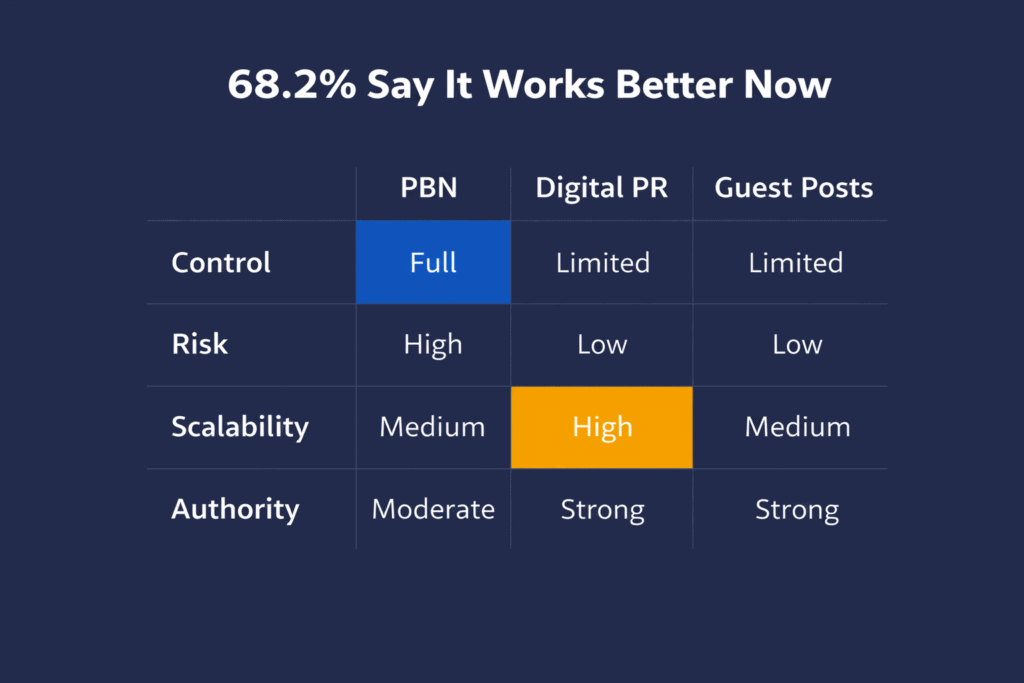
Confidence in Digital PR Is Rising: 68.2% of practitioners say digital PR works better now than it did a year ago. Tighter rules haven’t slowed them down. They’ve pushed the focus toward relevance and stronger placements.
KEY FINDINGS:
The Fastest Spam Update on Record: The March 2026 spam update ran from 12:00 PM PT on March 24 to 7:30 AM PT on March 25, finishing in under 20 hours. By comparison, the December 2024 update took 7 days, and August 2025 ran for 27 days. Source: Google Search Status Dashboard via Search Engine Journal
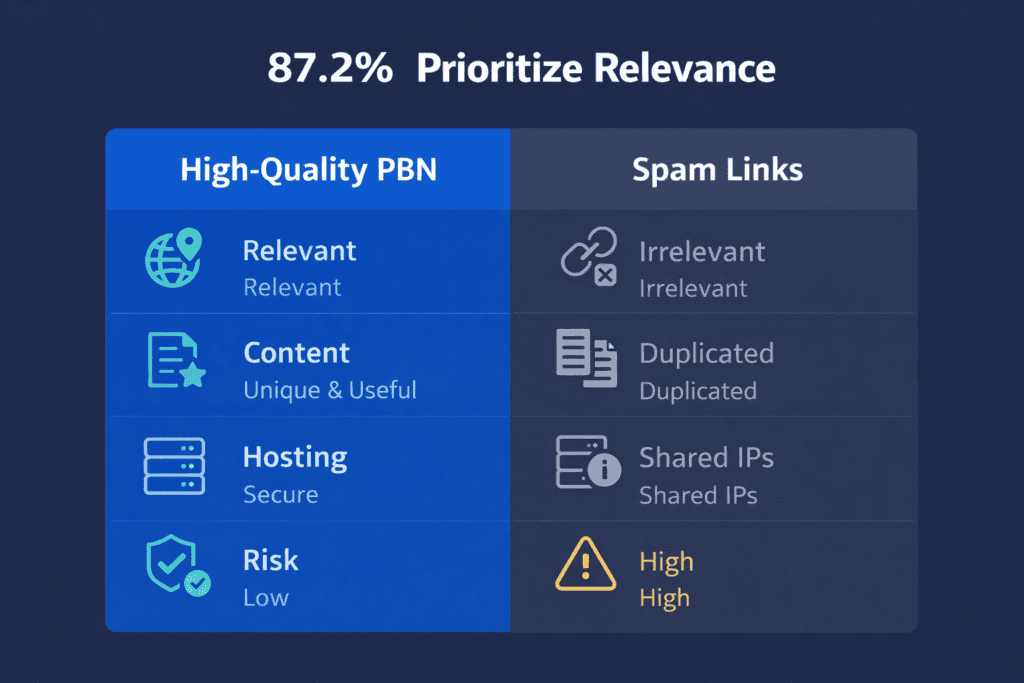
Relevance Leads All Metrics: 87.2% of digital PR professionals rank site relevance as the top factor in link quality. Source: Reboot Online / Motive PR
Search Still Drives Traffic: SEO accounts for about 53% of total website traffic, keeping organic search at the center of most strategies. Source: SEOLHR “Digital Marketing Statistics 2026”
Digital PR Keeps Growing: 68.2% say digital PR is more effective than last year, and 85.8% say building backlinks is the best use of their time. Sources: Motive PR & BuzzStream
A Large, Competitive Market: The global digital marketing market is projected to reach about 786+ billion dollars in 2026. Competition is high, and strong links still give an edge. Source: SEOLHR
WHAT THIS MEANS FOR BUSINESS OWNERS AND AGENCIES:
The idea that “any link helps” is gone. Google can now detect and discount weak link patterns, shared hosting networks, off-topic placements, and aggressive anchor text, often within a single day.
Backlinks still matter, but the focus has shifted. Relevance now leads the conversation. A single link from a site that actually fits your topic carries far more weight than dozens from unrelated or thin sites.
That shift changes how you choose partners and strategies. Price matters less than placement quality, editorial control, and how natural the link looks within the content.
“Google’s March 2026 spam update isn’t about killing PBNs. It targets low-quality link schemes,” said Samuel Huang, Founder and CEO of ArchSEO. “The 20-hour rollout shows how quickly patterns are flagged. Links need to make sense, match the topic, and sit on sites people would trust even without SEO.”
This analysis draws on data from Google’s Search Status Dashboard and industry surveys from BuzzStream, Motive PR, and Reboot Online, based on responses from digital PR and SEO professionals in early 2026.
This faster cycle leaves less room for shortcuts. Link building now depends on relevance, placement, and intent.
Google’s March 2026 spam update changed how link building works. Google confirmed the update rolled out in about 19.5 hours, making it unusually fast compared with prior releases. That speed is worth paying attention to. The short rollout suggests Google can deploy spam updates quickly, so site owners should monitor traffic and rankings closely during release windows.
If backlinks still drive your rankings, you’re not alone. The approach has shifted. Cheap links no longer hold up, and relevance and source quality now decide what works. The margin for error is smaller than it’s ever been.
Keep reading to see how this fight is being won on the ground, and what it means for choosing a safe provider and building links in a volatile era.
Key statistics on Google’s March 2026 spam update
Google’s March 2026 spam update landed fast and hit hard. It tightened link enforcement and pushed low-quality tactics further out of play. At the same time, demand for backlinks hasn’t dropped, it’s just shifted toward relevance and credibility.
Backlinks still matter. That hasn’t changed. What has changed is how easy it is to fake them. Google is better at spotting patterns, and weaker setups don’t hold up for long.
<20 hours rollout: the fastest spam update on record
The March 2026 update finished in under 20 hours. That’s unusually quick. Earlier updates took days or even weeks to fully roll out.
To put this in perspective, earlier updates took far longer. A quick comparison of recent rollouts:
Update Date
Rollout Duration
December 2024
7 days
August 2025
~27 days
March 2026
Under 20 hours
This speed is what stands out. It represents a significant shift in how Google operates. Updates move fast now. Outdated tactics break quickly, and there’s little time to react. The short rollout suggests Google can deploy spam updates almost instantly when they find systemic abuse.
Global Application: No Safe Zones for Link Spam
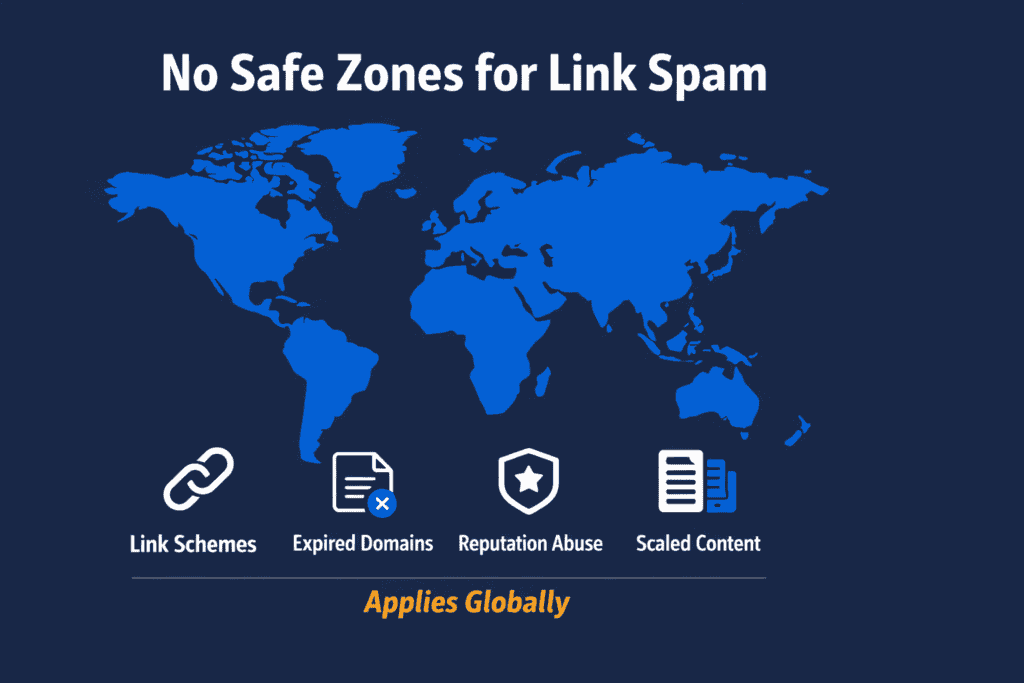
The update applies globally and to all languages, according to Search Engine Journal. It reinforced existing spam policies from Google Search Central, leaving no localized niches untouched.
The focus areas included:
Link schemes and manipulative link building
Expired domain abuse
Site reputation manipulation
Scaled content abuse
This isn’t just a localized algorithmic shift, it’s a structural crackdown. When a policy applies globally, there are no “safe niches” or regional loopholes. The bottom line: link quality matters more than link quantity, everywhere.
Improving SpamBrain: AI-Powered Detection in 2026
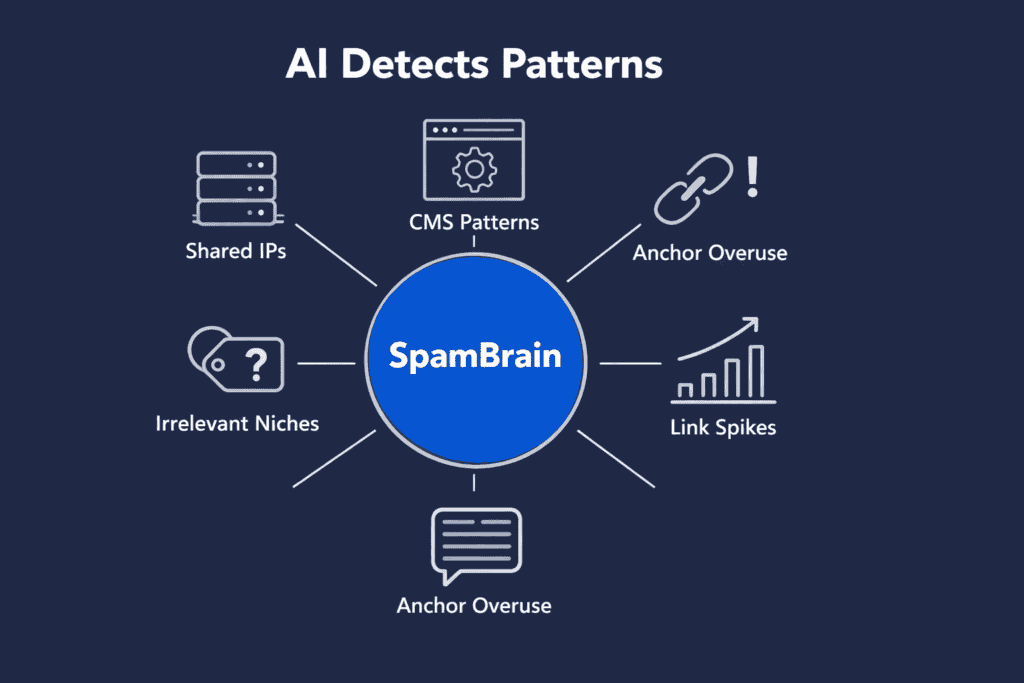
The update specifically improves Google’s SpamBrain system, as summarized by Syntactics, Inc.. SpamBrain uses AI to identify patterns in links, PBN networks, and backlink behavior. In 2026, it operates at scale and catches signals that would have slipped through before.
It doesn’t evaluate links individually. It looks at the full picture, including:
Shared hosting and repeated IP ranges
Similar CMS setups across many sites
Overused anchor text
Sudden spikes in link growth
Links between unrelated niches
This is exactly where cheap PBN setups fall apart. They reuse the same infrastructure and scale too aggressively. What worked a few years ago now gets quietly ignored.
53% of Website Traffic: The SEO Stakes
With organic search driving roughly 53% of all website traffic, according to SEOLHR, the stakes for surviving a spam update have never been higher.
Because organic traffic forms the majority of online visibility, losing rankings due to poor link choices can devastate a business. The focus now is precision. Bulk links don’t hold up. Each site needs to meet real quality standards.
If you discuss PBNs at all, frame them as a high-risk tactic rather than a recommended strategy. Google focuses on devaluation rather than manual penalties, meaning rankings often slide without any warning message in Search Console.
87.2% Rate Relevance as the Top Criterion
Relevance consistently appears as the top signal of link quality, with 87.2% of professionals citing site relevance as their primary evaluation criterion, according to Motive PR.
This perfectly illustrates the gap between PBN links and spam links. PBN links are controlled backlinks that can work if they’re relevant and well-built. Spam links are low-value, automated, or off-topic.
Factor
High-Quality PBN
Spam Links
Relevance
High
Low
Content
Unique, editorial
Thin or AI-generated
Hosting
Diversified
Shared footprints
Detection Risk
Medium
High
Relevance decides whether a link carries any weight. If a link was placed purely to move rankings and lacks topical alignment, SpamBrain is increasingly good at recognizing that.
85.8% Agree: Backlinks Are the Most Effective Tactic
Despite the risks, 85.8% of digital PR professionals say building backlinks remains the most effective tactic, according to BuzzStream.
The idea that backlinking is dead isn’t accurate. What stopped working is sloppy execution. Some SEOs continue to experiment with PBNs, though Google’s spam policies explicitly list repurposed expired domains as violations.
High-performing network setups focus on:
Niche-relevant domains with clean link histories
Content that reads like genuine editorial work
Natural posting patterns
85.1% Measure Success by Quality Links
A massive 85.1% of professionals measure success primarily by the number of quality links earned, according to BuzzStream.
This metric shifts the focus toward choosing the right providers. The best providers prioritize quality, relevance, and clean execution. Price and volume matter less than they used to.
What to look for in a provider:
Strong domain metrics (DA, DR, TF)
Clean backlink profiles with no spam signals
Natural publishing schedules
Hosting spread across different providers and IPs
Good providers are also transparent. You should be able to understand how and where links are placed. If the details are vague, that’s a red flag.
68.2% Find Link Strategies More Effective Now
Surprisingly, 68.2% believe that digital PR and link building are more effective now than they were 12 months ago, according to Motive PR.
This is largely because algorithm updates clear out the noise, rewarding those who execute well. A mixed approach holds up better over time, blending PBNs, digital PR, and guest posts.
Strategy
Control
Risk
Scalability
Authority
PBN
High
Medium
High
Medium
Digital PR
Low
Low
Medium
High
Guest Posts
Medium
Low
Medium
Medium
Relying on one method creates a single point of failure. A balanced mix spreads that risk, utilizing PBNs for targeted, niche-specific links and digital PR for strong authority signals.
$786+ Billion Industry: Protecting Your Network
With the global digital marketing industry projected to reach $786+ billion in 2026 according to SEOLHR, protecting your backlink investments is critical.
The main risks are footprint detection, irrelevant domains, aggressive anchor text, and poor-quality providers. These lead to links losing value, or, in serious cases, manual penalties.
Key risks include:
Shared hosting patterns across multiple PBN sites
Expired domains with bad backlink histories
Overuse of exact-match anchor text
Thin or duplicated content
One weak link rarely causes damage alone. Patterns do. That’s why the provider matters, a poorly built network leaves clear traces that threaten your slice of this massive industry.
Footprint Avoidance: Safe Hosting in 2026
Avoiding footprints comes down to variation. Hosting, site structure, and ownership signals all need to differ across your network. SpamBrain reviews infrastructure, not just links, which makes technical setup matter.
Best practices:
Use multiple hosting providers
Assign a unique IP to each domain
Register domains through different registrars
Use different CMS themes and plugin configurations
These steps reduce the chance of network-wide detection. Footprint control isn’t about complexity, it’s about not repeating yourself. Patterns are what detection systems catch first.
What Anchor Text and Link Velocity Work Safely?
Safe links rely on natural anchor text and steady, gradual link growth. The goal is to mirror how links appear on real websites. Google tracks how backlinks accumulate over time. Sharp spikes or repetitive anchor patterns get noticed quickly.
A balanced anchor profile includes:
Mostly branded anchors
Some partial-match anchors
Very few exact-match anchors
Links added slowly over weeks or months
When links get devalued, they don’t disappear, they just stop passing value. That’s why restraint matters more than volume.
How to Audit and Recover from PBN-Related Penalties
Recovery starts with a full backlink audit. The goal is to identify harmful links, remove them where possible, and rebuild a cleaner profile.
Steps to follow:
Use a backlink auditing tool to review your profile
Flag low-quality or irrelevant domains
Request link removals where possible
Submit a disavow file to Google
Recovery takes time, weeks to months before rankings stabilize. Trust rebuilds slowly. A mix of strong links from diverse sources helps. Many SEO teams now combine targeted placements with editorial links to stabilize results over time.
FAQ
How can I choose a safe PBN provider without risking penalties?
Choose a provider that clearly explains how they manage IP diversity, IP allocation, and server location across multiple data centers. They should avoid shared IPs and reduce hosting footprints through proper footprint minimization. Ask about server patterns and configuration patterns. A reliable setup reduces link manipulation signals and lowers the risk of detection by Google’s SpamBrain algorithm. Note: No PBN setup is completely ‘safe’ under Google’s current spam policies.
What hosting setup works best for PBN networks?
A balanced setup often works best. Providers may use VPS hosting, bulk buy hosting, or unmanaged hosts, while others offer managed options. The focus should be on clean IP addresses across different IP classes, including Class A, B, or C IP ranges. Proper server setup, DDoS protection, and intrusion protection are more important than choosing the cheapest option.
How important are content and CMS diversity in a PBN?
Content diversity plays a major role in keeping a network natural. Relying only on AI-generated content can increase risk under Google’s SpamBrain. A mix of writing styles works better. CMS diversity and CMS variation also help reduce patterns. If using WordPress hosting, rotate WordPress themes and WordPress plugins while maintaining WordPress compatibility for stable site management.
What security features should a PBN provider include?
A strong provider includes SSL certificates such as Let’s Encrypt SSL and other security services. They should protect against online attacks, including malformed data and SQL command injections. Features like automatic backups, intrusion protection, and network health monitoring help prevent issues that could lead to deindexed pages or loss of control over the network.
How do I evaluate PBN performance and SEO value?
Evaluate performance using SEO metrics such as DA check, TF check, and index and TF check tools. An indexation checker helps confirm that pages remain indexed. Site speed, server location, and content delivery networks also affect performance. Focus on consistent indexation and natural backlink acquisition instead of short-term gains that weaken long-term SEO stability.
Stricter Rules, Smaller Margin, Smarter Moves
Rankings drop faster now, and weak links stop working almost overnight. Systems like SpamBrain are built to detect patterns, not just links, which means shortcuts break quickly.
Arch SEO focuses on relevance-first link building with clean infrastructure and controlled execution, so your rankings don’t rely on tactics that stop working after the next update.
TLDR: In just 4 months, we built a Pinterest traffic system generating 1,030+ monthly visitors without spending a dollar on ads. Starting with just 5 pins per day and a dead-simple approach, we’ve created a Google-proof traffic source worth $1,545/month in equivalent ad spend. Below, we share our exact strategy so you can do the same.
While everyone else was panicking over Google’s latest algorithm update, we were quietly building a traffic pipeline that Google can’t touch.
Four months ago, our Pinterest account had zero traffic. Zero engagement. Zero everything.
Today, it drives over 1,030 visitors to our website every single month. That’s $1,545 worth of free traffic (based on average CPC rates) from a platform most SEO professionals completely ignore.
And the best part? We did it with minimal effort and absolutely no ad spend.
No complex keyword research. No expensive tools. No technical implementation nightmares.
Just a dead-simple approach that anyone can replicate – even if you’ve never used Pinterest for marketing before.
In this post, I’ll walk you through our entire process, from how we started with just 5 pins per day to how we’re scaling to 100 daily pins. I’ll share the exact visual elements that made our pins stand out, our scheduling strategy, and the surprising lessons we learned along the way.
The Journey: From 0 to 1000+ Monthly Website Clicks in Just Few Months
Month 1: December 2024 – Starting Small
Strategy: Started with just 5 pins per day
Content Focus: Simply created pins for our existing blog posts
Results: 306 outbound clicks to our website
Key Learning: Consistency matters more than complex strategy initially
During this first month, we focused on establishing our Pinterest presence. Rather than overthinking our approach, we simply took our existing blog post URLs and created basic pins for them. We committed to consistent daily pinning of 5 pins, focusing on building a steady presence rather than expecting overnight results.
Month 2: January 2025 – Unexpected Growth
Strategy: Maintained 5 pins daily but improved pin design
Content Focus: Continued creating pins for our existing content library
Results: 920 outbound clicks to our website
Key Insight: One particular pin gained significant traction, showing the viral potential
January brought an unexpected surge in traffic. We discovered that one of our pins had gained unusual traction, demonstrating Pinterest’s potential for viral distribution that simply doesn’t exist with Google. This reinforced that Pinterest isn’t just about consistent growth—it has the potential for exponential traffic spikes when content resonates with users.
Month 3: February 2025 – The Pinterest Delay Effect
Strategy: Increased to 10 pins daily
Content Focus: Continued pinning our content library, no complex strategy
Results: 794 outbound clicks to our website
Key Lesson: Pinterest has a “delay effect” as the algorithm processes new content
February showed a slight decline in click numbers, which we identified as the “Pinterest delay effect.” When you increase pinning frequency, the Pinterest algorithm often takes time to process and distribute this new content volume. This temporary dip is normal and shouldn’t discourage you from maintaining your strategy. The foundation was being built for future growth.
Month 4: March 2025 – Consistent Growth Path Established
Strategy: Maintained 10 pins daily
Content Focus: Same straightforward approach: creating pins from our content library
Results: 1,030 outbound clicks to our website
Key Win: Confirming that we’ve established a consistent growth trajectory
By March, we had established a reliable traffic pattern. The “Pinterest delay effect” from February had resolved, and we were seeing steady, predictable growth. This confirmed our approach was working and gave us confidence to plan further scaling. Most importantly, this traffic was completely independent from Google’s algorithm changes.
Pinterest Strategy Deep Dive: What Actually Worked
1. Simple Content Approach
The most surprising discovery was that we didn’t need a complex content strategy:
Content Source: We simply used our existing blog post URLs
No Keyword Targeting: We didn’t spend time researching Pinterest keywords
Universal Appeal: We created pins for all our content, not just “Pinterest-friendly” topics
Focus on Quantity: Building a large library of pins proved more valuable than perfectionism
2. Visual Differentiation
While our strategy was simple, we did learn that pins with these characteristics consistently outperformed others:
Bold, dynamic typography that commands attention and remains readable even on mobile screens
Vibrant, contrasting colors that pop against Pinterest’s white background and stand out in crowded feeds
Creative, artistic backgrounds that create visual interest without overwhelming the text
Clear value proposition communicated instantly through the headline (“10 Steps,” “Master the Art,” etc.)
Thematic visual elements that reinforce the content topic (for us is art supplies, drawing tools, etc.)
As you can see in our examples, we focused on creating pins with strong visual impact through bold lettering, vibrant colors, and artistic design elements. The combination of eye-catching typography and relevant imagery helps users immediately understand the value of clicking through to the content. Each pin maintains a unique look while following consistent principles that drive engagement.
3. Scaling Strategy
Our approach to scaling was deliberate to prevent potential Pinterest penalties:
Month 1-2: 5 pins per day to establish account credibility
Month 3-4: 10 pins per day as we built momentum
Planned Growth: Planning to scale to 20-100 pins per day to reach 10,000 monthly clicks
7-Day Repin Cycle: We began repinning our content on a 7-day cycle to maximize reach without appearing spammy
4. Time-Efficient Workflow
We developed a streamlined process that minimized time investment:
Batching: Creating pins in batches of 50-100 at a time
Templates: Using AI to speed up creation time
Scheduling: Using Pinterest’s built-in scheduling to maintain consistency
Repurposing: Creating multiple pin designs for the same content to maximize reach
The Pinterest Advantage for SEO Professionals
Why Pinterest Should Be Part of Every SEO Strategy
Algorithm Diversification: As Google’s updates become more unpredictable, Pinterest provides a stable traffic source unaffected by core updates or helpful content changes.
Compounding SEO Benefits: Pinterest traffic sends valuable user signals to Google:
Increased direct traffic (a known ranking factor)
Lower bounce rates from engaged visitors
More time on site and pages per session
Potential for increased brand searches (a major Google ranking signal)
Content Recovery: Pinterest can drive traffic to pages that lost Google rankings, allowing you to maintain visibility while working on SEO recovery.
No Technical Barriers: Unlike complex SEO strategies, Pinterest doesn’t require technical implementation, making it accessible to everyone.
The Real Value of Pinterest Traffic
While 1,030 clicks per month may not seem life-changing, consider these important factors:
Low-Effort Implementation: This traffic was achieved with minimal effort—just consistently creating and posting pins without complex strategies or technical implementations.
Scaling Potential: With more in-depth keyword research and increased posting frequency (up to 100 pins per day), reaching 10,000+ monthly clicks is entirely realistic.
Conversion Value: Depending on your niche, even modest traffic can be highly valuable. For affiliate sites, a single high-ticket conversion can mean hundreds or even thousands of dollars in commission—making even a few hundred targeted visitors extremely valuable.
Monetary Equivalent: 1,030 clicks at an average Google Ads CPC of $1.50 equals $1,545 in “free advertising” per month—or $18,540 annually.
Cumulative Growth: Unlike paid traffic that stops instantly when you stop paying, Pinterest traffic continues growing month after month, creating a sustainable asset.
Looking Forward: Scaling to 10,000+ Monthly Clicks
Based on our growth trajectory, we’ve established a clear path to 10,000+ monthly website clicks from Pinterest:
Expanding gradually from 10 pins per day to 100 pins per day through a combination of new content and strategic repinning
Maintaining our simple but consistent approach without overcomplicating the strategy
Continuing to improve pin designs based on performance data
Implementing our 7-day repin strategy to maximize the value of existing content
With our current growth rate, we project reaching 10,000 monthly clicks by the end of 2025, creating a substantial traffic source completely independent from Google’s algorithm changes.
For Those Short on Time: Our Pinterest Management Service
Implementing a successful Pinterest strategy requires consistent effort. If you recognize the potential but lack the time to execute, our Pinterest management service offers:
Professional Pin Creation: Custom-designed pins optimized for engagement at just $1.99 per pin
Complete Pinterest Management: Full-service option including uploading and scheduling for $2.49 per pin
Strategic Implementation: Applying the same proven techniques that generated our results
Conclusion
In this case study, I’ve shown you how to:
Build a Pinterest traffic system that generated 1,030 monthly visitors in just 4 months with minimal effort and zero ad spend
Implement a simple, consistent pinning strategy starting with just 5 pins per day and scaling to 10+ pins daily
Create visually compelling pins that stand out in Pinterest feeds using bold typography, vibrant colors, and clear value propositions
Utilize a 7-day repin cycle that maximizes reach without triggering Pinterest’s spam detection
Develop a Google-resistant traffic source worth $1,695/month in equivalent ad spend that continues to compound over time
Leverage Pinterest traffic to potentially improve your Google rankings by sending positive user signals back to the search algorithm
The most valuable insight from our experience is that you don’t need complex strategies, expensive tools, or technical expertise to succeed with Pinterest. Simply showing up consistently with basic pins for your existing content can drive significant traffic growth.
As Google’s algorithm becomes increasingly unpredictable, having a diversified traffic portfolio isn’t just smart—it’s essential for long-term sustainability.
Ready to Diversify Your Traffic?
Don’t let your website remain dependent on Google’s unpredictable algorithm changes. Start building your Pinterest traffic pipeline today.
Are you ready to elevate your website’s search engine rankings, boost organic traffic, and amplify your brand’s visibility? The secret lies in mastering the art of outreach link building. In this comprehensive guide, we’ll explore the ins and outs of link building outreach, discuss best practices for crafting effective outreach emails, and introduce you to essential tools and resources for a successful link building campaign. Let’s dive into the world of outreach link building and unlock its full potential!
Key Takeaways
Outreach link building is an essential component of SEO, involving the cultivation of a strong backlink profile to stand out in digital environments.
Developing an effective strategy involves identifying a target audience, producing content that appeals to them and analyzing competitors’ backlink profiles.
Common outreach link building mistakes such as targeting irrelevant websites or ignoring follow ups should be avoided for successful campaigns. Success can be measured by tracking key performance indicators including ranking improvement and domain authority growth.
Understanding Outreach Link Building
The competition in the digital realm is fierce, making it increasingly difficult to secure a top spot in search engine results pages (SERPs). The key to standing out lies in cultivating a robust backlink profile through a well-executed link building outreach process.
But what exactly is outreach link building, and why is it so vital for SEO success?
What is Outreach Link Building?
Outreach link building involves reaching out to pertinent websites, bloggers, and influencers to obtain high-quality backlinks for a link building outreach campaign. Establishing connections with influencers who share similar audiences allows you to benefit from their credibility and authority to gain valuable links. This may include guest blog posts, mentions on social media, or securing links on third-party web pages.
The Skyscraper technique, for example, involves creating high-quality content on a topic that websites are already linking to, increasing the chances of earning backlinks.
Importance of Link Building in SEO
Outreach link building plays a crucial role in enhancing search engine rankings, augmenting organic traffic, and magnifying brand visibility. Obtaining valuable backlinks can increase your website’s credibility in the eyes of search engines, leading to higher rankings and improved visibility across different sites.
Moreover, it demonstrates the popularity and authority of your website, further contributing to its SEO success.
Developing an Effective Link Building Strategy
Initiating an outreach link building campaign might seem intimidating, but with a strategic plan and a clear comprehension of your target audience, you can produce meaningful content that aligns with their interests and enhances your probability of acquiring backlinks.
This section covers the following topics:
The significance of identifying your target audience
Producing content worth sharing
Scrutinizing competitors’ backlink profiles to devise an effective link building strategy.
Identifying Your Target Audience
Recognizing your target audience is essential for link building, as it helps you create content that resonates with them and increases the likelihood of securing backlinks. Understanding your target audience enables you to identify the websites and platforms they frequent, allowing for more effective outreach and link placement.
Moreover, targeting the right audience ensures that the quality links are placed on sites that are relevant and valuable to your target audience, enhancing the quality and authority of the backlinks.
Creating Share-Worthy Content
Content that is worth sharing is vital for link building as it aids in attaining more backlinks, thereby improving the whole link building process. High-quality content that is compelling, educational, and captivating has the potential to be shared on social media, blogs, and other websites, thus increasing the likelihood of obtaining backlinks.
By creating content that resonates with your target audience, you can increase the chances of them engaging with and sharing your content, leading to more backlinks.
Analyzing Competitors’ Backlink Profiles
Analyzing your competitors’ backlink profiles can provide valuable insights into potential link building opportunities and help you understand the industry landscape. By identifying the backlinks pointing to your competitors’ content, you can contact those people and request they link to your content instead.
This competitive analysis enables you to uncover new link building opportunities and refine your outreach strategy for maximum success.
Best Practices for Outreach Emails
Crafting effective outreach emails is a critical component of a successful link building campaign. In this section, we will discuss best practices for creating outreach emails that grab the attention of your target audience and increase the likelihood of earning backlinks.
Personalization
Personalizing your outreach emails is crucial for increasing the chances of getting a positive response and building long-term relationships. By taking the time to research your outreach targets and tailor your messages to their interests and needs, you can demonstrate genuine interest in their content and increase the likelihood of them engaging with your email.
Remember, a thoughtful and personalized message can go a long way in building a strong connection with your target audience.
Compelling Subject Lines
Compelling subject lines are crucial for grabbing the recipient’s attention and improving email open rates. Here are some tips for creating effective subject lines:
Keep your subject lines concise
Clearly communicate the purpose of the email
When seeking links in mentions, express gratitude first
For attribution link requests, include “Attribution request” in the subject line
The right subject line can make all the difference in capturing your target audience’s attention and increasing the chances of earning a backlink.
Clear Call-to-Action
In every outreach email, it’s important to include a clear call-to-action (CTA) that guides the recipient on the desired action you want them to take. Whether you’re asking them to provide a backlink, share your content on social media, or collaborate on a guest post, a clear CTA can help increase the chances of earning a backlink.
Remember, a well-crafted CTA can be the deciding factor between a successful outreach email and one that goes unanswered.
Tools and Resources for Outreach Link Building
In the competitive digital realm of today, possessing the appropriate tools and resources can significantly influence the success of your link building outreach campaign. This section presents a variety of tools and resources that can simplify and optimize your link building initiatives.
Link Building Tools
Link building tools can help you find potential link building opportunities, analyze backlink profiles, and manage your outreach efforts. Some popular link building tools include Linkody, Ahrefs, Sitechecker, Moz Link Explorer, and SEMrush. These tools can assist in locating potential contacts, acquiring email addresses, generating customized email templates, and monitoring the outcomes of your link building outreach campaigns.
Armed with the right tools, you can streamline your link building process and increase your chances of success.
Email Outreach Tools
Email outreach tools can greatly assist in managing and automating the outreach process, increasing efficiency and success rates in your link building campaign. Some of the most effective email outreach tools for link building include:
Woodpecker
NinjaOutreach
BuzzStream
Pitchbox
Hunter.io
These tools, known as link building outreach tool, provide features for personalized and efficient outreach, relationship-based outreach, tracking, and tools to discover link opportunities, track progress, and manage link building efforts.
By leveraging email outreach tools, you can streamline your outreach efforts and focus on building valuable relationships with your target audience, while ensuring your messages don’t end up in their spam folder.
Collaboration Platforms
Collaboration platforms play an important role in the link building process by providing a centralized space for your team to share and collaborate on tasks, ideas, and resources. Some tools that can help improve your team’s communication and coordination in the link building process include:
Mailshake
Right Inbox
GroupHigh
BuzzStream
NinjaOutreach
BuzzSumo
Voila Norbert
Using these tools can ensure that all parties are informed and the link building process runs smoothly.
By utilizing collaboration platforms, you can streamline your link building efforts and ensure that your team is working together effectively.
Common Outreach Link Building Mistakes to Avoid
Like any marketing strategy, certain common mistakes should be avoided in outreach link building. This section highlights the most common errors in link building campaigns and provides guidance on avoiding them to ensure the success of your outreach endeavors.
Targeting Irrelevant Websites
Targeting irrelevant websites in your link building campaign can result in low-quality backlinks and negatively impact your SEO efforts. It’s important to focus on building links from relevant and authoritative websites to ensure the most favorable outcomes.
By doing so, you can increase your website’s credibility in the eyes of search engines, leading to higher rankings in search results and improved visibility across different sites.
Over-Automation
While automation can be helpful in streamlining certain aspects of outreach link building, over-automation can lead to impersonal outreach emails and lower success rates. Excessive automation can also result in a lack of control and oversight, making it difficult to identify or address any potential errors.
It is important to strike a balance between automation and manual efforts to ensure the efficacy and credibility of your outreach process.
Ignoring Follow-Ups
Ignoring follow-ups in your link building campaign can have a detrimental impact on its success. By not following up, you may miss out on beneficial responses and potential link prospects. Research has shown that follow-ups can significantly boost response rates in email outreach, so it’s crucial to make follow-ups a part of your outreach strategy.
By being persistent and dedicated in your outreach efforts, you can increase your chances of building lasting relationships and earning valuable backlinks.
Measuring the Success of Your Outreach Link Building Campaign
To accurately measure the success of your outreach link building campaign, monitoring key performance indicators that mirror the impact of your efforts is necessary. This section covers how to gauge the success of your link building campaign by monitoring:
Backlinks
Improvements in ranking
Growth in organic traffic
Enhancement in domain authority
Tracking Backlinks
Tracking backlinks is a crucial aspect of measuring the success of your link building strategy. By monitoring the number and quality of backlinks your website is earning, you can assess the effectiveness of your outreach efforts and make informed decisions to optimize your backlink strategy.
Tools such as Linkody, Ahrefs, Sitechecker, Moz Link Explorer, and SEMrush can help you keep track of your backlinks and ensure the health of your website’s backlink profile.
Track your Ranking Improvement
Monitoring your website’s search engine ranking improvements can provide valuable insights into the impact of your link building efforts on your search engine rankings. By keeping an eye on your search rankings, you can evaluate the effectiveness of your link building strategy in driving targeted traffic to your website.
Tools such as Semrush, Google Search Console, SE Ranking, Ahrefs, Wincher, and Whitespark can help you track your ranking improvements and optimize your link building efforts.
Analyzing Organic Traffic Growth
Analyzing organic traffic growth is another essential metric for assessing the overall success of your link building campaign. By monitoring the growth of organic traffic to your website, you can evaluate the effectiveness of your link building efforts in driving targeted traffic to your site.
Google Analytics is an invaluable tool for tracking organic traffic growth and understanding how your link building efforts are impacting your website’s performance.
Assessing Domain Authority Improvement
Last but not least, assessing domain authority improvement is an important indicator of how your link building efforts are contributing to the overall authority and credibility of your website. Tools such as:
Moz Domain Authority Checker
Ahrefs
Majestic
SEMRUSH
can help you evaluate your website’s domain authority and understand the impact of your link building efforts on your website’s overall authority.
Summary
In conclusion, outreach link building is an essential component of any successful SEO strategy. By understanding the concept of link building, developing an effective link building strategy, adhering to best practices for outreach emails, utilizing the right tools and resources, and avoiding common mistakes, you can maximize the potential of your link building efforts and catapult your website to the top of search engine rankings. The road to SEO success starts with mastering the art of outreach link building – so why wait? Start building valuable relationships and earning high-quality backlinks today!
Frequently Asked Questions
What is the link building outreach process?
Link building outreach involves reaching out to people online and asking them to link back to your website, in order to build brand awareness and grow your target audience.
Does link building still work?
Link Building is still an effective SEO strategy, with search engines taking the quantity and quality of links into account when ranking websites. High-quality links can significantly boost a website’s ranking on SERPs.
What is building outreach?
Link building outreach is the process of creating valuable links from other websites by reaching out to people on the Internet. Its goals are to build brand awareness, grow target audiences and boost search engine rankings.
What is the link building concept?
Link building outreach is the process of creating valuable links from other websites by reaching out to people on the Internet. Its goals are to build brand awareness, grow target audiences and boost search engine rankings.
What is the primary objective of outreach link building?
The primary objective of outreach link building is to acquire high-quality backlinks from relevant and authoritative websites in order to improve search engine rankings, increase organic traffic, and boost brand visibility.
In today’s competitive online landscape with AI content and everyone publishing 100 content per day, guest posting remains a powerful tool for businesses to gain SEO advantage, search visibility and establish authority. However, to fully harness its potential, one must be aware of the common pitfalls and best practices. We aims to demystify “what is a guest post”, delve into its importance, and provide effective strategies for success while avoiding common mistakes.
Key Takeaways
Guest posting is a form of content marketing to increase online presence, build relationships and authority, and boost SEO.
Businesses can use guest blogging to gain recognition, showcase expertise, create referral traffic and leads.
Adhere to best practices for successful outcomes in both guest posting & SEO by creating high quality content & obtaining backlinks while avoiding spammy tactics.
Understanding Guest Posts: Definition and Purpose
The concept of guest posting has grown in popularity over the years, but what exactly is it? A guest post is an article written by an individual for another website, usually featuring a bio of the author and a link to their site. With so many guest post ideas out there, it’s essential to find the right fit for your target audience.
The primary goals of guest posting are relationship building, audience expansion, and SEO enhancement through backlinks.
Definition of Guest Posts
Guest posts, also known as guest blog posts or guest blogs, are articles authored by external contributors for publication on another website. This allows the guest blogger to:
Showcase their expertise through a well-crafted guest blog post
Increase their online presence and improve E-E-A-T
Potentially drive referral traffic to their own website through the inclusion of a bio and a link to their site.
Purpose of Guest Blogging
As a potent content marketing tool, guest blogging aids in fostering relationships, expanding the audience base, and boosting SEO via backlinks. By writing guest posts on relevant websites, businesses can tap into new market segments, establish authority in their industry, and foster long-lasting connections with potential customers and influencers. One might ask, why is guest blogging so effective? It’s because it allows for mutual benefits between the host website and the guest author, creating a win-win situation for both parties.
The Importance of Guest Posting for Businesses
Businesses stand to gain immensely from guest posting, from heightened brand recognition and demonstrated expertise to creating referral traffic and leads. In fact, many businesses accept guest posts as a way to diversify their content and provide valuable insights to their audience. One effective way to achieve these benefits is to write guest posts for other businesses in your niche.
Let’s explore these benefits in more detail.
Boosting Brand Awareness
Guest blogging offers the potential to:
Reach a new audience by featuring guest posts on other websites
Leverage the guest bloggers’ personal networks to share the content
Expand businesses’ reach and create connections with industry influencers
Maximize visibility on search engines
Heighten brand awareness
This increased exposure helps businesses expand their reach, create connections with industry influencers, and maximize visibility on search engines, ultimately leading to heightened brand awareness.
Establishing Authority and Credibility
Guest posting is an effective way to establish E-E-A-T authority and credibility within a particular industry or niche. By providing valuable content on other organizations’ websites, guest bloggers can showcase their expertise, enhance their industry reputation, and engender trust among potential customers and partners.
Generating Referral Traffic and Leads
Guest blogging can be a powerful strategy for businesses to increase website traffic, conversions, and lead generation. By sharing valuable content on high-traffic websites relevant to their industry, guest bloggers can attract interested readers from these platforms, leading to increased referral traffic and potential leads.
Effective Strategies for Guest Posting Success
Adhering to certain key strategies can help guarantee the success of your guest blogging endeavors. These include identifying the right websites to target, crafting compelling content that resonates with your audience, and building relationships with blog owners.
Here’s a closer look at these strategies.
Identifying the Right Websites
Selecting pertinent, high-traffic websites for guest posting optimizes exposure and benefits. By targeting websites closely aligned with your niche, you can ensure that your content will resonate with the audience, increasing the likelihood of engagement and conversions.
Utilizing tools such as Ahrefs and conducting thorough research can help you identify suitable websites for guest posting.
Crafting Compelling Content
The success of your guest posts hinges on the creation of engaging, high-quality content. Focus on providing value to the target audience by addressing their pain points, answering their questions, and offering actionable advice. Incorporate visual elements such as infographics, charts, and high-quality photographs to make your content more appealing and informative.
Building Relationships with Blog Owners
Fostering relationships with blog owners can increase the likelihood of guest post acceptance and pave the way for future collaborations. Engage with blog owners by commenting on their posts, sharing their content on social media, and offering genuine compliments.
When submitting guest post pitches, personalize your approach and demonstrate your knowledge of their website and audience by following the guest post guidelines. It also helps to offer payment to the webmaster for publishing your content, as a recognition of their time and effort.
Common Guest Posting Mistakes to Avoid
Guest posting brings numerous benefits, but it’s also crucial to steer clear of common mistakes that could impede your progress. These include prioritizing quantity over quality, neglecting outreach and relationship-building, and ignoring promotion and engagement.
Let’s examine these pitfalls in more detail.
Prioritizing Quantity Over Quality
Focusing on producing a large number of guest posts without considering their quality can lead to several negative outcomes, such as reduced blogging success, lower engagement, and weaker connections with your audience. Instead, concentrate on creating high-quality guest posts that provide value, establish trust, and contribute to your brand’s visibility and reputation.
Moreover, the presence of toxic links in your guest posts can severely harm your website’s SEO efforts. Toxic links are those that come from low-quality or spammy sites and can lead to penalties from search engines, ultimately reducing your site’s visibility and credibility. These links are often a result of overzealous link-building practices that neglect the importance of link quality.
Additionally, it’s crucial to be mindful of link velocity—the rate at which you acquire backlinks. An unnaturally fast accumulation of links can signal manipulative practices to search engines, leading to negative SEO consequences. Balancing link acquisition with quality content creation is key to maintaining a healthy and effective SEO strategy.
Neglecting Outreach and Relationship-Building
Outreach and relationship-building are crucial aspects of guest posting success. By establishing connections with blog owners and engaging with their content, you increase the likelihood of guest post acceptance and lay the groundwork for future collaborations.
Invest time in personalizing your outreach efforts and genuinely engaging with your target blog owners to forge strong relationships with those who have their own blog.
Ignoring Promotion and Not Building Tiered Links
Promoting your guest posts on social media and engaging with readers are crucial for maximizing guest blogging benefits. Sharing your content on various platforms and engaging in conversations with your audience increases exposure, establishes authority, and provides valuable feedback for future content.
In addition to these strategies, using Tier 2 links like those from Private Blog Networks (PBNs) can boost your guest posts’ performance. Directing traffic from these sources to your main article enhances reach and strengthens your site’s SEO.
However, these tactics should be used carefully due to potential risks. Additionally, sharing your content on social media is key for boosting social signals such as likes, shares, and comments, which are important ranking factors for search engines. They indicate your content’s popularity and relevance, improving your site’s visibility and credibility. Combining effective promotion with strategic link building can significantly improve your guest blogging efforts
Guest Posting and SEO: Best Practices and Guidelines
Guest posting and SEO complement each other, with adherence to appropriate practices and guidelines fostering successful outcomes in both domains. To make the most of your guest blogging efforts, focus on creating high-quality content, avoiding spammy tactics, and monitoring success to optimize your future guest blogging endeavors.
Let’s explore these best practices in more detail.
High-Quality Content and Backlinks
Creating valuable content and earning high-quality backlinks are essential for effective guest blogging and SEO. Ensure that your guest posts provide useful information, are well-researched, and contribute to the overall value of the host website.
This will help you secure valuable backlinks, which can boost your website’s search engine rankings and overall SEO performance.
Avoiding Spammy Tactics
Guest posting solely for link-building purposes can be detrimental to your website’s SEO rankings. Google considers such practices as unnatural link manipulation and may penalize your website accordingly. To avoid these negative consequences, focus on creating high-quality guest posts that provide value to the readers, and do not engage in excessive link-building tactics.
Monitoring and Measuring Success
Monitoring and measuring the success of your guest posts is essential for optimizing your guest blogging endeavors. Here are some metrics to track and analyze:
Website traffic
Social shares
Search engine rankings
Engagement
By evaluating these metrics, you can gain valuable insights into the efficacy of your guest posts and identify areas for improvement. This will help you refine your guest blogging strategy moving forward.
Summary
Guest posting remains a powerful tool for businesses to enhance brand visibility, establish authority, and generate leads. By following effective strategies such as targeting relevant websites, crafting compelling content, and building relationships with blog owners, you can maximize the benefits of guest blogging. Avoid common pitfalls like prioritizing quantity over quality, neglecting outreach, and ignoring promotion and engagement. Adhere to SEO best practices, and monitor your guest post performance to continually optimize your efforts. With persistence and dedication, guest posting can be a game-changer for your business’s online success.
Frequently Asked Questions
What do you mean by guest post?
Guest posting, also known as guest blogging, is the act of writing and publishing content on another website to reach a wider audience, improve search engine rankings, and establish one’s brand as an authority.
Should you accept guest posts?
Accepting guest posts can help diversify your content and offer different perspectives to your readers. This can be beneficial for topics where you don’t have personal experience or lack authority.
Why do we need guest posts?
Guest blogging is an important tool for increasing brand trust, building brand awareness, expanding visibility, driving referral traffic, establishing yourself as a thought leader, and gaining SEO-boosting backlinks. It is an effective way to reach new audiences and establish credibility with readers, influencers, and Google.
What is the main purpose of guest blogging?
Guest blogging’s main purpose is to build relationships, increase brand visibility, and boost SEO through backlinks.
How do I identify the right websites for guest posting?
Research relevant, high-traffic websites in your industry or niche with tools like Ahrefs’ Content Explorer to identify the right websites for guest posting. Make sure the answer follows a professional tone and contains no extraneous artifacts. Ensure the answer connects with the reader and ends with a clear conclusion.
Imagine having the power to enhance your website’s search engine rankings and visibility without writing new content or starting from scratch. This is where link insertion comes into play. As a pivotal SEO technique, link insertion allows you to secure high-quality backlinks from authoritative and topically relevant websites. But how exactly can you master link insertion to ensure long-term success? Let’s find out.
Key Takeaways
Link insertion is an SEO practice that strategically adds a website’s link to existing content on related websites.
Relevance and authority must be taken into consideration when selecting potential sites for link insertions, as well as analyzing domain metrics and trustworthiness.
Link insertion pitfalls such as over optimization and ignoring search engine guidelines should be avoided in order to maximize the effectiveness of your campaign.
Understanding Link Insertion: A Comprehensive Overview
Link insertions, also known as link placements, are a strategic SEO practice that involves inserting your website’s relevant link into existing content on related websites. This technique differs from other link building strategies, such as guest posting and broken link building, in that it focuses on adding links to existing content rather than creating new content or replacing broken links. One effective method for achieving this is through link placement in high-quality articles or blog posts that are relevant to your niche.
Definition and Purpose
At its core, link insertion is the process of embedding a link to your website within an existing piece of content on a related website. To insert external links effectively, one must aim to boost search engine rankings and visibility, thus playing a significant role in a successful SEO strategy.
The evolution of link insertion in SEO has seen a shift towards quality over quantity, with a focus on natural and relevant link placements. This change in approach, driven by the introduction of Google’s Penguin algorithm update in 2012, has led to the rise of outreach campaigns, where external links are placed within existing content on relevant websites, avoiding the need to create original content and enabling quicker outreach.
How It Differs from Other Link Building Strategies
Unlike guest posting, which involves creating and publishing unique content on external websites, link insertion focuses on adding a link to an existing article or blog post. Guest posting allows you to demonstrate your expertise and establish credibility with your target audience, while link insertion offers a cost-efficient and time-saving approach to gaining backlinks.
In contrast to broken link building, which aims to identify broken links on other websites and replace them with your own content, link insertion strategically places your own links within existing content on other websites to enhance user experience and improve SEO. While broken link building concentrates on replacing broken links, link insertion is all about inserting new links into existing content.
The Importance of Relevance and Authority in Link Insertion
Selecting relevant and authoritative websites is essential for ensuring successful link insertion. The relevance of inserted links is key, as it enriches reader experience and assists search engines in comprehending the context and subject matter of the linked website. Similarly, domain authority plays a significant role in link insertion, as it lends credibility and trust to the inserted link, with links from high authority domains being more likely to positively impact search engine rankings.
Choosing Topically Relevant Websites
To be topically relevant for link insertion, a website must have relevant content and a topic that align closely with the website’s relevant link being inserted. Ensuring that the website includes related information that complements the link’s content helps to guarantee that the link is placed in an appropriate and meaningful context, thus increasing its effectiveness for SEO purposes.
Selecting topically relevant websites for link insertion offers numerous advantages, such as enhanced relevance, higher quality backlinks, amplified website traffic, quicker indexing, and a cost-efficient strategy. Some factors to take into account when selecting a relevant website include its content’s connection to the link, the website’s authority and trustworthiness, the quality of its content, and the website’s traffic and engagement metrics.
Evaluating Domain Authority and Trustworthiness
Metrics such as domain authority, page authority, and trust flow are pivotal in assessing the authority and trustworthiness of a website for link insertion. By analyzing these metrics, you can ensure that the websites you choose to insert your links on have a high level of credibility and trust.
One should weigh the quality and credibility of the target website prior to link insertion. Using unrelated or low-authority websites for link insertion may have several negative consequences, including:
Harm to credibility
Lower search engine ranking
Risk of blacklisting
Reduced link value
Hence, a careful evaluation of a potential target website’s authority and trustworthiness is mandatory before proceeding with link insertion.
Implementing an Effective Link Insertion Campaign
A successful link insertion campaign encompasses a multi-step process of identifying potential websites, scrutinizing their metrics, and carrying out outreach and negotiation. By following this comprehensive approach, you can ensure that your link insertion campaign yields optimal results and contributes positively to your website’s SEO.
Identifying Potential Websites
Utilizing tools such as:
Backlink Gap by Semrush
Majestic SEO’s Clique Hunter
Content Explorer
Hunter.io
You can identify potential websites for link insertions. Researching and identifying topically relevant websites with quality content and solid search engine rankings is a crucial step in ensuring the effectiveness of your link insertions.
Once you have identified potential websites, it is important to analyze their traffic and engagement rates to ensure they align with your desired target audience. By focusing on websites that have a significant amount of traffic and an engaged audience, you increase the probability that your inserted links will be clicked on and lead to increased visibility and organic traffic for your website.
Analyzing Website Metrics
Prior to link insertion, one should analyze the target website’s metrics including:
Domain authority
Dofollow/nofollow attributes of the link
Competitor backlink profiles
Relevance and quality of content
Number of backlinks to the specific page
By thoroughly evaluating these metrics, you can ensure that the inserted links contribute positively to your website’s SEO.
Some tools that can be utilized to analyze website metrics for link insertion are:
Google Analytics
Moz
Statcounter
Chartbeat
These tools can provide insights into the website’s traffic, engagement, and overall performance, allowing you to make an informed decision about whether or not to proceed with link insertion.
Outreach and Negotiation
Conducting outreach to site owners, including website owner, is a crucial step in the link insertion process. Reaching out to them with a professional and customized message, explicitly stating your intention, and offering value by explaining how the link insertion will benefit their audience can increase the likelihood of securing link insertion opportunities.
Negotiating with website owners is also an essential aspect of link insertion. By clearly articulating the value you are providing and explaining how the link insertion will be beneficial to their audience, you can establish mutually beneficial relationships that enhance your website’s SEO and contribute to the overall success of your link insertion campaign.
Anchor Text Optimization for Link Insertions
Optimizing anchor text is essential for effective link insertions. Anchor text dictates how the link will be presented and whether it will be clicked, so precise, succinct, and persuasive anchor text is vital for successful link insertion.
Selecting Descriptive and Relevant Anchor Text
Choosing descriptive and relevant anchor text is crucial for ensuring that your link insertions provide value and context for both users and search engines. Anchor text should accurately reflect the linked content, allowing users to understand what they can expect when they click on the link and helping search engines associate the linked URL with specific keywords or key phrases.
When selecting anchor text for link insertion, it is important to avoid using too many exact match keywords, as this can lead to over-optimization and potential penalties from search engines. Instead, focus on diversifying your anchor text and using a range of relevant and natural phrases to ensure the effectiveness of your link insertions.
Balancing Keyword Variations
Balancing keyword variations in anchor text is essential for maintaining a natural link profile and preventing over-optimization. By incorporating different variations of keywords in link insertions, you can enhance the relevance and visibility of your links in various search results, improving your overall SEO strategy and increasing the likelihood of attracting organic traffic to your website.
Incorporating keyword variations into your link insertion strategy can help to increase your website’s visibility and reach a larger audience. By diversifying your anchor text and using a range of relevant and natural phrases, you can create a balanced and effective link insertion campaign that positively impacts your website’s SEO performance.
Monitoring and Evaluating Link Insertion Success
Monitoring and evaluating the performance of your link insertion campaign is key to its ongoing success. By tracking key performance indicators (KPIs) and adjusting your strategy based on performance data, you can refine your approach to maximize the SEO benefits of your link insertions.
Tracking Metrics and KPIs
Tracking metrics such as organic traffic, search engine rankings, and referral traffic can help you measure the effectiveness of your link insertions. Using tools such as SEMrush, Ahrefs, Moz Pro, Majestic SEO, and BuzzSumo, you can track these KPIs and gain insights into the success of your link insertion campaign.
In addition to tracking these KPIs, you can also use Google Analytics to monitor link insertion performance, including link clicks and revenue generated from those clicks. By analyzing this data, you can determine the success of your link insertion campaign and make informed decisions about your future link building strategies.
Adjusting Strategy Based on Performance
Modifying your link insertion strategy according to performance data is critical to maximize the SEO benefits of your campaign. By analyzing the performance of your inserted links, you can identify areas for improvement and adjust your strategy accordingly, ensuring that your link insertion efforts are as effective as possible.
Some adjustments you might consider include altering the anchor text, targeting alternative websites, or utilizing different link insertion techniques. By continually refining your approach and adapting to the ever-changing landscape of SEO, you can ensure the long-term success of your link insertion campaign.
Common Link Insertion Pitfalls to Avoid
Being aware of common pitfalls like over-optimization and disregard for search engine guidelines is important for the long-term success of your link insertion campaign Avoiding these pitfalls can help you maintain a natural link profile, prevent penalties, and maximize the benefits of your link insertions.
Over-Optimization
Over-optimization, such as using the same anchor text repeatedly or excessively optimizing internal links, can lead to search engine penalties and negatively impact your website’s SEO. To prevent over-optimization, it is important to:
Diversify your anchor text
Use a range of relevant and natural phrases in your link insertions
Ensure that your link profile remains balanced and effective.
Ignoring Search Engine Guidelines
Ignoring search engine guidelines, such as engaging in manipulative link building practices or paying for links, can result in penalties and harm your website’s reputation. To circumvent these issues, adherence to search engine guidelines and best practices is essential, which ensures your link insertion campaign remains ethical and effective.
Summary
Link insertion is a powerful SEO technique that, when executed properly, can significantly enhance your website’s search engine rankings and visibility. By understanding the intricacies of link insertion, selecting relevant and authoritative websites, optimizing anchor text, and monitoring and evaluating your campaign’s success, you can maximize the benefits of your link insertions and ensure the long-term effectiveness of your SEO strategy.
Remember to stay vigilant in avoiding common pitfalls and adhering to search engine guidelines, as this will help you maintain a natural and balanced link profile that contributes positively to your website’s SEO. By continually refining your approach and adapting to the ever-changing landscape of SEO, you can ensure the long-term success of your link insertion campaign.
Frequently Asked Questions
What is a link insertion?
Link insertion is the practice of adding a link to one’s website into the content of another website. It is typically done through outreach to authoritative and topically relevant websites, in order to benefit the reader’s experience.
What does it mean to insert the link?
Link insertion involves adding your website’s link to the content of another website to increase traffic and create a better user experience. It involves connecting with topically relevant and authoritative websites for effective backlinking.
Is link insertion good for SEO?
Link insertion is an essential part of a successful SEO strategy and helps to improve website authority, credibility, and rankings. Therefore, it is good for SEO.
What is the difference between link insertion and guest posting?
Link insertions involve editing existing content to insert a link, while guest posting involves writing new content to be published on another website with a link.
How does link insertion differ from guest posting and broken link building?
Link insertion involves adding a link to an existing article or webpage, unlike guest posting which involves creating and publishing unique content on external websites, or broken link building which aims to identify and replace broken links with your own content.
Are you aiming to enhance your website’s SEO rankings and curious about Private Blog Networks (PBNs)? With SEO strategies constantly evolving, understanding the impact of PBNs is crucial. This blog post will provide a concise yet comprehensive overview of PBNs, discussing their advantages, potential risks, and ethical implementation for SEO success in 2023.
Key Takeaways
PBNs are powerful link building tools that can be used to generate high-quality backlinks and customize anchor text.
When utilizing PBNs, caution must be taken due to potential penalties from search engines.
Setting goals and tracking KPIs is key for measuring the effectiveness of a Private Blog Network while practicing ethical SEO practices is essential for successful implementation.
Understanding Private Blog Networks (PBNs)
Private Blog Networks (PBNs) have been a hot topic in the SEO world for quite some time. A PBN’s main goal is to alter the search engines’ view of a target website’s popularity and authority, leading to an improved position in search engine result pages (SERP). Utilizing private blog network SEO strategies can be a controversial yet effective method for achieving higher rankings.
Manipulating search engine rankings via PBNs brings both benefits and drawbacks, which we’ll investigate further in the subsequent sections.
The Role of PBNs in Link Building
PBNs are a key tool for controlling backlinks and boosting a website’s authority, making them a preferred method for link building. By producing high-quality backlinks, PBNs strengthen a website’s authority, which in turn can enhance its search engine rankings. Their efficiency in creating backlinks, also referred to as PBN links, has earned them significant popularity among SEO agencies.
Customizing anchor text in PBNs can facilitate search engine comprehension of the linked content’s context and relevance, thereby enhancing a website’s rankings for specific keywords. This is achieved by creating links pointing to the target website with relevant anchor text.
Tier 2 Link Building With PBN
Tiered link building is an effective approach to enhancing a website’s authority and rankings by creating a tier structure of high quality links that makes it difficult for search engines to identify private blog networks. The structure involves:
High-quality and authoritative websites linking to the target website (Tier 1)
Websites linking to Tier 1 (Tier 2)
Lower-quality or less-relevant sources linking to Tier 2 (Tier 3)
Tier 2 link building involves utilizing private blog network pbn to link to your Tier 1 backlinks, such as high-authority guest posts, link insertions, or digital PR links. This approach adds a layer of security by concealing the direct connection between your primary website and the PBNs, making it more challenging for search engines like Google to identify and penalize these links. The added security of being in Tier 2, coupled with the enhanced domain authority from these additional link layers, makes this a strategic and effective method for improving your website’s overall performance.
PBN Components and Structure
The components of Private Blog Networks (PBNs) include domain acquisition, content creation, and the implementation of on-page and off-page SEO strategies. Effectively comprehending and managing these components is vital for the successful operation of a PBN.
The Benefits and Drawbacks of Using PBNs
As with any SEO tactic, PBNs come with their own set of benefits and drawbacks. Despite their ability to improve search engine rankings and domain authority, PBNs carry risks, including potential penalties from search engines.
We’ll delve further into the benefits and risks associated with PBNs in the subsequent sections.
Advantages of PBNs
One of the primary benefits of using PBNs is the increased control over backlinks, targeted anchor text, and improved search engine rankings. This control allows website owners to build links at their own pace and on their own terms, without relying on the sometimes slow and unpredictable process of link outreach and content marketing. PBNs can provide quicker results and be more cost-effective in creating new links compared to other methods.
Additionally, the use of PBNs offers the advantage of accelerated results due to their existing link profile when acquiring expired domains. This can be particularly beneficial for new websites looking to establish their online presence quickly.
Risks and Consequences
However, the use of PBNs is not without risks. Employing PBNs for link building carries a degree of risk, as Google and other search engines can impose penalties on websites that engage in unnatural link building tactics. Utilizing PBNs contravenes Google’s Webmaster Guidelines and carries considerable risks, such as:
Heightened risk, administration, and expenditure
Potential penalties and decrease in rankings
Disregarded links
The likelihood of being punished or deindexed by search engines
Moreover, using PBNs could result in a decrease in organic traffic and a possible decrease in a website’s reputation. Website owners must carefully evaluate the potential benefits and risks of PBNs prior to incorporating them into their SEO strategy.
Steps to Creating and Managing a PBN
Grasping the required steps to establish and manage a PBN is fundamental for those contemplating this SEO tactic. We’ll outline the domain acquisition and research process, content creation and optimization, and the implementation of on-page and off-page SEO strategies in the subsequent sections.
Domain Acquisition and Research
The first step in setting up a PBN is domain acquisition. It is essential to investigate and pinpoint the desired domain names, examine their availability and pricing, and register the selected domain name through a domain registrar or web hosting service. When acquiring domains for a PBN, it is important to ensure that the websites have not been hit by Google penalties, experienced significant drops after algorithm updates, or hosted restricted content such as adult or gambling-related material.
Obtaining expired domains for a PBN offers the advantage of accelerated results due to their existing link profile. This can help improve the primary website’s search engine rankings more quickly. However, it is crucial to carefully research and select expired domains to ensure their link profiles are clean and relevant to the target website.
Content Creation and Optimization
Once the domains have been acquired, the next step is content creation and optimization. It is vital to:
Research the topic
Create content optimized for search engines
Ensure the content is of high quality
The content should be original, relevant, and engaging, providing value to the readers while also helping to improve the website’s search engine rankings.
In addition to creating high-quality content, it is essential to optimize it for search engines. This involves incorporating relevant keywords, meta tags, and other elements to ensure that the content is easily discovered and indexed by search engine bots. Proper content optimization will help boost the website’s search engine rankings and increase organic traffic.
On-Page and Off-Page SEO Strategies
Effective PBN management requires a strong emphasis on on-page SEO strategies, as well as the development of social profiles. On-page SEO for PBNs involves optimizing the website’s content to enhance relevance and user experience. This includes careful implementation of keywords, meta tags, building links to authoritative links and developing a cohesive internal linking structure. Also crucial is creating content that boosts topical relevance, ensuring that each PBN site is perceived as authoritative in its specific niche.
Apart from on-page optimization, establishing social media profiles for each PBN site is beneficial. Social profiles can:
Enhance the perceived legitimacy and reach of the PBN sites.
Provide additional pathways for traffic to flow to the main site.
Help in creating a more realistic and engaging online presence for each PBN site.
While traditional off-page SEO strategies like external link building from other websites aren’t typically necessary for PBNs, the creation and maintenance of social profiles play a key role in bolstering the effectiveness of a PBN network. This approach contributes to a more comprehensive online presence, assisting in the overall SEO strategy for the primary website.”
Moreover, it is essential to ensure that the website is indexed correctly by search engines, as this will play a significant role in the website’s search engine rankings.
Detecting and Avoiding PBN Footprints
Detecting and avoiding PBN footprints is essential to preserving your PBN’s credibility and protective measures. This involves diversifying hosting and IP addresses and varying site design and CMS platforms.
These strategies will be discussed in greater detail in the subsequent sections.
Diversifying Hosting and IP Addresses
Using different hosting providers and IP addresses can help maintain the credibility and protection of PBNs, making them less detectable by search engines. By employing various:
Domain registrars
Hosting providers
IP addresses
CMS platforms
Themes
Plugins
You can effectively diversify your PBN and reduce the likelihood of being discovered by search engines.
Diversifying your PBN not only makes it more robust and durable but also helps protect your primary website from potential penalties. By spreading your PBN across multiple hosting providers and IP addresses, you can minimize the risk of your entire network being discovered and penalized by search engines.
Varying Site Design and CMS Platforms
In addition to diversifying hosting and IP addresses, it is essential to vary site design and CMS platforms to reduce the likelihood of PBN detection and ensure a more natural link profile. This can be achieved by:
Using different themes for each PBN website
Using different plugins for each PBN website
Using different content management systems for each PBN website
Varying site design includes the following steps:
Goal identification
Scope definition
Creation of a sitemap and wireframe
Content creation
Design of visual elements
Testing
Launch
By employing a diverse range of designs and platforms, you can make your PBN appear more like a collection of independent websites rather than a network designed to manipulate search engine rankings.
Measuring PBN Effectiveness
Setting goals and monitoring progress is key to assessing your PBN’s effectiveness and ensuring its ongoing success. We’ll discuss goal setting, progress monitoring, and strategy adjustment based on outcomes in the subsequent sections.
Setting Goals and Monitoring Progress
When utilizing PBNs, it’s important to set specific goals related to enhancing search engine rankings and increasing organic traffic. This involves defining objectives that are not only measurable and achievable but also aligned with your overall SEO strategy. Focus on setting targets that clearly quantify the expected improvements in rankings and traffic within a set timeframe.
To effectively monitor these goals, keep a close eye on Key Performance Indicators (KPIs) such as improvements in search engine rankings and organic traffic volumes. Utilize tools like Google Analytics, Ahrefs, and Moz to track these metrics. Regular monitoring allows you to assess the direct impact of your PBN on your primary website’s performance. By focusing on these specific KPIs, you can gauge the effectiveness of your PBN in driving tangible results and make necessary adjustments to optimize its contribution to your overall SEO efforts
Adjusting Strategies Based on Results
Analyzing the data collected from tracking your KPIs will provide valuable insight into the effectiveness of your PBN and enable the determination of areas for improvement. Based on the insights gained, you can adjust your PBN strategies, such as optimizing content, diversifying hosting and IP addresses, and varying site design and CMS platforms.
Continuous monitoring and adjustment of your PBN strategies are essential for ensuring long-term success and maintaining compliance with search engine guidelines. By staying informed about the latest SEO trends and best practices, you can ensure that your PBN remains an effective tool for improving your primary website’s search engine rankings.
Google’s Stance on PBNs and Ethical Considerations
Google maintains a strict stance against PBNs due to their guideline violations and potential for penalties. Website owners must consider the ethical aspects of using PBNs and balance their usage with sustainable SEO practices.
We’ll delve into Google’s stance on PBNs and discuss maintaining ethical SEO practices while using PBNs in the subsequent sections.
Google Guidelines and Penalties
Google opposes PBNs due to their manipulative nature and may impose penalties on websites that use them. Google’s guidelines explicitly indicate that constructing links to a website artificially is a violation, and this includes PBNs. Utilizing PBNs can lead to a considerable decrease in organic traffic due to Google enforcing penalties on websites that employ them.
Manual penalties can be issued by Google reviewers against websites found to have unnatural links, such as those created by PBNs. If a manual penalty is issued, a warning message will be sent to the website owner through Google Search Console. To avoid Google penalties, it is essential to adhere to ethical SEO practices and use PBNs sparingly and responsibly.
Balancing PBN Use with Sustainable SEO Practices
To maintain ethical SEO practices, it is crucial to balance PBN usage with sustainable strategies such as content development, link outreach, and guest blogging. While PBNs can be employed in moderation to supplement an SEO campaign, it is important to prioritize quality content generation and adhere to search engine guidelines.
Cultivating a varied backlink profile is essential for SEO success. By focusing on content creation, link outreach, and guest blogging, you can create a diverse range of quality backlinks without relying solely on PBNs. This approach will help ensure long-term success and maintain compliance with search engine guidelines.
Summary
In conclusion, Private Blog Networks can be a powerful tool for boosting your website’s search engine rankings when used responsibly and ethically. By understanding the benefits and drawbacks of PBNs, creating and managing them effectively, avoiding footprints, and balancing their use with other sustainable SEO practices, you can harness the power of PBNs to enhance your website’s online presence in 2023. Remember, while PBNs can offer quick results, it is essential to prioritize long-term success and ethical SEO practices to ensure your website’s continued growth and visibility.
Frequently Asked Questions
What is a PBN in SEO?
A PBN in SEO is a network of websites used to link back to a central website, influencing its authority in search.
How do you identify a PBN?
To identify a PBN, look for sites with fewer content than usual and low-quality content. Also pay attention to poor visuals and bad writing, as these are common traits of PBNs.
Do PBNs still work?
Yes, PBNs still work. Despite some thinking after 2019 that PBNs had become obsolete, they continue to be effective in 2023 as long as backlinks remain a ranking factor.
Are PBNs considered black hat SEO?
PBNs are generally seen as a gray hat SEO technique, as they are not considered black hat nor endorsed as white hat. Their use is therefore not recommended.
Wait a minute….. “white hat, google safe, and not bots/tools”? What else can I hope for! My mind is set and I decided to go with this gig. Before I place the order, I will need a website to test this gig.
It can’t be my PBN nor my money site (for obvious reasons), I need a site where everyone who reads this blog can check it on Ahrefs and verify themselves. So I came up with a brilliant idea on which domain to use for this test. (Which I will reveal later, so keep reading!)
So it began, I anxiously waited for the gig to be completed but it took longer than I expected.
I placed the order on April 5 and the deadline was supposed to be 30 days.
I check my Ahrefs every day, nothing happened from April 5 to April 20. On the 21st of April, I started to see a HUGE bunch of links coming in on Ahrefs. Are you guys ready for this?
As I’ve expected, they are using some SEO Tools (GSA/ SENUKE) to blast out links and they manage to force index on all those links. What about the DR / UR / Ahrefs Rank?
Wow, a remarkable increase in DR in a matter of days! My DR went from 5 to 26 in one day and slowly went up to as high as 42 over the weeks. And look at the UR, it’s 81! I’m considered one of the top authority websites now!
Let’s take a look at our referring domains section to see what kind of link building they have done.
Wow! DR 90+ do-follow links from Google, .gov, .edu, Baidu, and more authority sites! You have to be impressed by that, those links are nearly impossible to get. Before we get overly excited with the links, let’s take a deeper look.
Are you starting to see a pattern? The four screenshots above are redirected links to my website. Yes, in case you haven’t noticed, I put this website (archseo.com) on the frontline for this special case study so you guys can check it out on Ahrefs yourselves. I went over to the backlinks column in Ahrefs to take a look, and indeed almost all the links Ahrefs show are redirected links.
Here’s what showed up when I tried to access the backlinks:
One of the things I’ve observed is that even though all those links are redirected links, there are 2 different types.
Type A: Instant Redirect (Click here for example) – Not working as of July 2022 This type of link redirects instantly once you click on it. Think of it like a tracking link you use on your affiliate website.
Type B: Gateway Redirect (Click here for example) – Not working as of July 2022 This type of link shows you a gateway page before they redirect. It usually comes with a text saying “You’re being redirected, Click here to continue” etc.
The 3 example photos we sent above are Gateway Redirect.
In Ahrefs referring domain section, we can see that there was a split between 80% of Instant Redirect (Type A), the remaining 20% as normal links (Type B)
Those links are really easy to manipulate, you can literally change the URL to redirect the site you wanted.
And you have the same effect. I’m going to try to index the new links I’ve just created using an indexer and see what happens. And oh! Don’t worry. If you think I’m screwing someone else’s site, I own weblinksbroker.com as well, it’s a sister site that provides outreach links service.
In total, I’ve received a total of 10k Unique backlinks (or should I call it, “redirect links”) from this Fiverr gig.
I’m going to break down the DR of the backlink (or should I say redirect?)
DR 90 and above = 29
DR 80 to 89 = 116
DR 60 to 79 = 971
DR 40 to 59 = 1537
DR 20 to 39 = 4200
DR 0 to 19 = 3627
From what you can see, I am getting really good DR links for what I paid for. With so many high DR links pointing at this website, I’ve no doubt that it will boost my DR. On top of that, I am getting an insane UR boost on my website with UR 81! (Anyone wants a backlink from me? :p)
However, does it help with the ranking? Unfortunately, I can’t give you an answer on this as I didn’t optimize this website for ranking and it’s not exactly “Google friendly”. Everything about this website goes against Google guidelines. However, if you must know, I only had 1 organic keyword in Ahrefs before this began, and it’s still the same now. I guess it doesn’t help but perhaps it might increase someday down the road–who knows?
One of the downsides of this is the sheer number of new referring domains being built and indexed overnight. Think about the link velocity. I’ve have 32 referring domains on April 21 , on April 22 it shot up to 2.2k which eventually it reached 10k+. This surge does not look good on your link profile.
Speaking of link profiles and metrics, this calls for some concern. If you recall when I mentioned earlier that unethical link sellers might inflate the DR or other metrics with just a few dollars and try to sell your DR 40/50/60 backlink for a premium amount.
Rule of thumb: If you’re buying link insertion or guest post, always check the metrics history and their backlink before buying. Buying links off pure metric is going to get you into trouble with Google in the long run. Ahrefs have a DR history section where you can easily check the link before making any decision.
What’s next?
I’m will wait to see if there is any penalty coming from Google and will actually test it on a page that I want to rank. This can potentially be use for churn and burn. I might also handpick a few good redirect links to use on some of my main money sites and test if it helps to move the needle.
Remember buying any gig off Fiverr that claims to boost your DR / Ranking is going to cost you a lot down the road.
ArchSEO provide quality links building (Both PBN and Outreach Links). If you need any help with the following feel free to approach our team to find out more.
Updated on JUL 2022 –
Here the metrics changes after 1 year
DR dropped from 41 to 22.
UR dropped from 81 to 41.
RD from 10.5k to 1.26k.
Backlinks from 20.6k to 2.75k.
There is no manual penalty from Google Search Console.
The Laziest & Free Way To Get An Almost Perfect Score In All Website Speed Test Tools
If you’re like me, trying to do all the good things in Google instead of finding that magic ranking ‘loophole’ to game the system, you will know that page speed is one of the key ranking factors. Not only a ranking factor, but it will also help your visitor to stay, reduce bounce rate and eventually increase your conversion rate.
I’ve tried different plugins and tools that are supposed to help you improve your website speed and Time to First Byte (TTFB). Even after installing and optimising all of these different plugins and tools, none of them really came close to giving me a high score on the major website speed test sites.
Here are some types of plugins/tools that a lot of us will install/use to improve our website speed:
CDN
Image Optimization/Compression
Lazy Load
Cache
In this case study, we are going to see if there is one plugin that can replace everything above and in fact, do a better job with minimal effort.
Introducing Nitropack
One day I saw this plugin being recommended in a Facebook group as the “Holy grail of pagespeed” plugin. One plugin that does all of the above combined. I decided to investigate and see if it can be incorporated into my website. It was called “Nitropack”.
Most reviews out there will tell you how the process works and explain to you all the technical jargon. But as an end user, what we want to do is simple: install the plugin and see if it delivers the results as promised. If it works it works, if it doesn’t we’ll keep finding the next best solution.
Isn’t that the point of using a plugin? We all want something that we can just set, activate and forget.
For this case study, I will install the plugin on this current website so that everyone can enter the URL into the website speed test sites to see the result for themselves. I will do a before and after comparison on these 3 major website speed test sites:
On each of them I will run the test 3x and get the average. This is to ensure that my test is of the highest accuracy and not affected by any bugs on those sites.
Before I run the test, here are the existing plugins that we’re using:
Litespeed Cache
Shortpixel Image Optimizer
Lazy Load – Optimize Images
Don’t get me wrong, I’m not saying that those 3 plugins are bad and should be replaced. In fact, they are quite popular and with the proper settings, they could help you improve your page speed / load time. But even with these, it requires quite a decent amount of technical knowledge to score really high in the 3 major website speed test sites. And what we are looking for is a set-and-forget solution without fumbling through the settings and watching tonnes of YouTube videos to find the perfect ones for our website.
Speed Test Result (Before)
As mentioned earlier, we ran through all of them 3x with the average scores on the far-right.
Pingdom
Pingdom
Result #1
Result #2
Result #3
Average
Performance Grade
D (68)
D (68)
D (70)
68.6 (D)
Page Size
1.2MB
1.2MB
1.2MB
1.2MB
Load Time
1.28s
866ms
863ms
1.003s
Request
64
64
64
64
Gtmetrix
Gtmetrix
Result #1
Result #2
Result #3
Average
Pagespeed Score
B (82%)
B (82%)
B (82%)
B (82%)
YSlow Score
C (77%)
C (77%)
C (77%)
C (77%)
Fully Load Time
4.5s
2.7s
3.6s
3.6s
Total Page Size
1.07MB
1.07MB
1.07MB
1.07MB
Request
64
64
64
64
Google PageSpeed (Desktop)
Google PageSpeed
Result #1
Result #2
Result #3
Average
First Contentful Paint
1.2s
1.3s
1.2s
1.23s
Speed Index
2.4s
4.0s
2.3s
2.9s
Largest Contentful Paint
2.8s
2.7s
2.0s
2.5s
Time To Interactive
2.6s
2.8s
2.8s
2.73s
Total Blocking Time
0ms
40ms
20ms
20ms
Cumulative Layout Shift
0.035
0.035
0.035
0
Score
70
65
77
70.66
Google PageSpeed (Mobile)
Google PageSpeed
Result #1
Result #2
Result #3
Average
First Contentful Paint
4.3s
4.3s
4.2s
4.27s
Speed Index
7.7s
11.2s
6.9s
8.6s
Largest Contentful Paint
4.4s
4.4s
4.2s
4.33s
Time To Interactive
10.6s
9.7s
10.5s
9.6s
Total Blocking Time
260ms
390ms
340ms
330ms
Cumulative Layout Shift
0.072
0
0.072
0.048
Score
52
46
53
50.33
Installing Nitropack
Once I had gotten the results from all the major website speed testers, I placed an order with Nitropack that has both paid and free plans.
In this example, I’m just going to use the free plan as I’m optimising this Archseo website, which is not going to rank for any keywords and also because we have very few pages. At the same time, I don’t want this case study to be a biased review if you have to pay just to get the benefits of these tools.
A free plan means that everyone can optimise their website for free. The free plan comes with a 200-page optimization limit and you will need to give them sitewide footer links.
You can scroll to the bottom to take a look and experience it yourself.
The paid plan can be quite expensive when compared to other similar tools. If you’re on a budget, or your site is not making as much money for you to invest in this plugin, a free plan will work just fine. It’s just one outbound link in the footer, so it’s not going to affect your website much. You can always switch to a paid plan once you start making more money from your site.
All you have to do is to install the Nitropack plugin, and connect using the API found in your new account.
Once this is done, I will set the setting to ‘Ludicrous’ for the best optimization. However, please ensure that you backup your site, so that in the event anything goes wrong, you will still be able to restore it.
Sit back and let it do its job – it will take a few days up till a week, depending on how large your website is.
Speed Test Result (After)
After about 2 weeks, I checked back on the results. Here you go:
Pingdom
Pingdom
Result #1
Result #2
Result #3
Average
Performance Grade
A (98%)
A (98%)
A (98%)
A (98%)
Page Size
1.9MB
1.9MB
1.9MB
1.9MB
Load Time
852ms
450ms
473ms
591.67ms
Request
77
77
77
77
Gtmetrix
Gtmetrix
Result #1
Result #2
Result #3
Average
Pagespeed Score
A (99%)
A (99%)
A (99%)
A (99%)
YSlow Score
A (99%)
A (99%)
A (99%)
A (99%)
Fully Load Time
2.9s
1.8s
2.7s
2.46s
Total Page Size
215KB
215KB
215KB
215KB
Request
12
12
12
12
Google PageSpeed (Desktop)
Google PageSpeed
Result #1
Result #2
Result #3
Average
First Contentful Paint
0.3s
0.4s
0.3s
0.33s
Speed Index
0.9s
1.0s
0.9s
0.93s
Largest Contentful Paint
0.7s
0.7s
0.3s
0.57s
Time To Interactive
0.3s
0.4s
0.3s
0.33s
Total Blocking Time
0ms
0ms
0ms
0ms
Cumulative Layout Shift
0
0
0
0
Score
100
99
100
99.67
Google PageSpeed (Mobile)
Google PageSpeed
Result #1
Result #2
Result #3
Average
First Contentful Paint
1.2s
1.2s
1.1s
1.17s
Speed Index
2.6s
2.5s
2.2s
2.43s
Largest Contentful Paint
1.2s
1.2s
1.1s
1.17s
Time To Interactive
3.7s
3.7s
3.7s
3.7s
Total Blocking Time
140ms
210ms
110ms
153.33ms
Cumulative Layout Shift
0
0
0
0
Score
98
98
99
98.3
Conclusion
I take the average of both before and after from each speed testing website. And put into table below for easy reference.
Pingdom
Pingdom
Before
After
Performance Grade
D (68%)
A (98%)
Page Size
1.2MB
1.9MB
Load Time
1.28s
591.67ms
Request
64
77
Gtmetrix
Gtmetrix
Before
After
Pagespeed Score
B (82%)
A (99%)
YSlow Score
C (77%)
A (99%)
Fully Load Time
4.5s
2.46s
Total Page Size
1.07MB
215KB
Request
64
12
Google PageSpeed (Desktop)
Google PageSpeed
Before
After
First Contentful Paint
1.23s
0.33s
Speed Index
2.9s
0.93s
Largest Contentful Paint
2.5s
0.57s
Time To Interactive
2.73s
0.33s
Total Blocking Time
20ms
0ms
Cumulative Layout Shift
0
0
Score
70.66
99.67
Google PageSpeed (Mobile)
Google PageSpeed
Before
After
First Contentful Paint
4.27s
1.17s
Speed Index
8.6s
2.43s
Largest Contentful Paint
4.33s
1.17s
Time To Interactive
9.6s
3.7s
Total Blocking Time
330ms
153.33ms
Cumulative Layout Shift
10.6
0
Score
50.33
98.3
As you can see from the above chart, we saw drastic improvements in just 2 weeks. All we did was install, activate and forget about it. And best of all, it’s FREE. There is no reason why you wouldn’t do it, unless you’re really concerned about having one sitewide footer outbound link.
If this is a concern for you, chances are you’re probably getting a decent amount of traffic from your website, so you could possibly choose the cheapest plan at $19/month to see if it performs well for you.
While doing this test, I asked Nitropack if they had any discount code that I could share, and they created one for me “ARCH10OFF”. Use this code to get 10% off your first purchase (you save more when you get a yearly plan) and yes, I do get an affiliate fee if you sign up using my coupon code.
In order to use this coupon code you need to click using my link.
Ultimately, the end-goal of installing this plugin and improving your page should get you:
Higher Ranking in Google:
More Conversion:
I hope you liked this case study. If you have any questions, feel free to email me at samuelh@archseo.com or leave a comment down below, and I will get back to you as soon as I can!