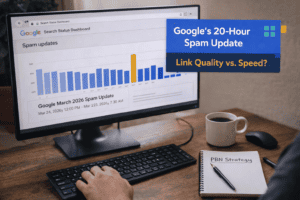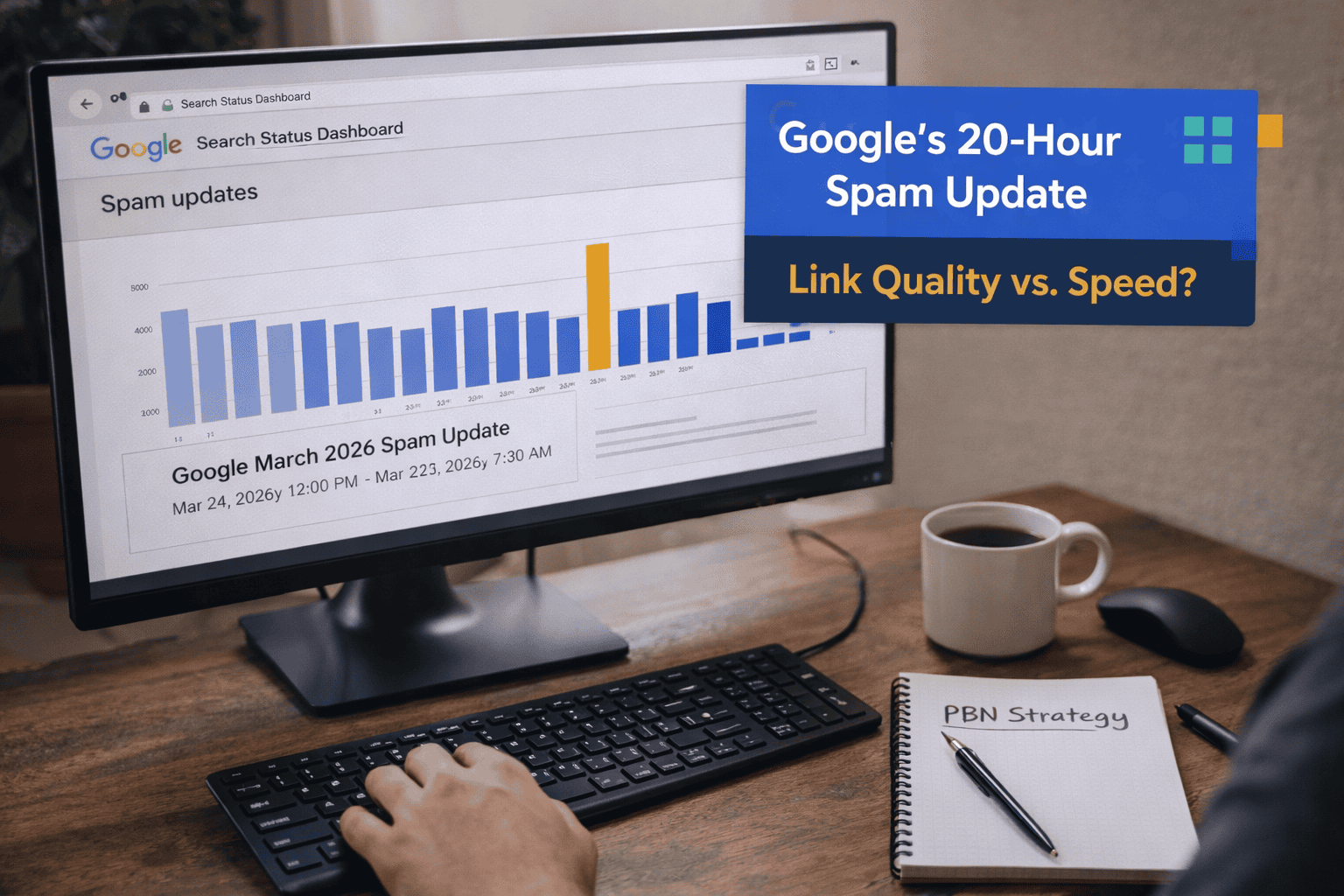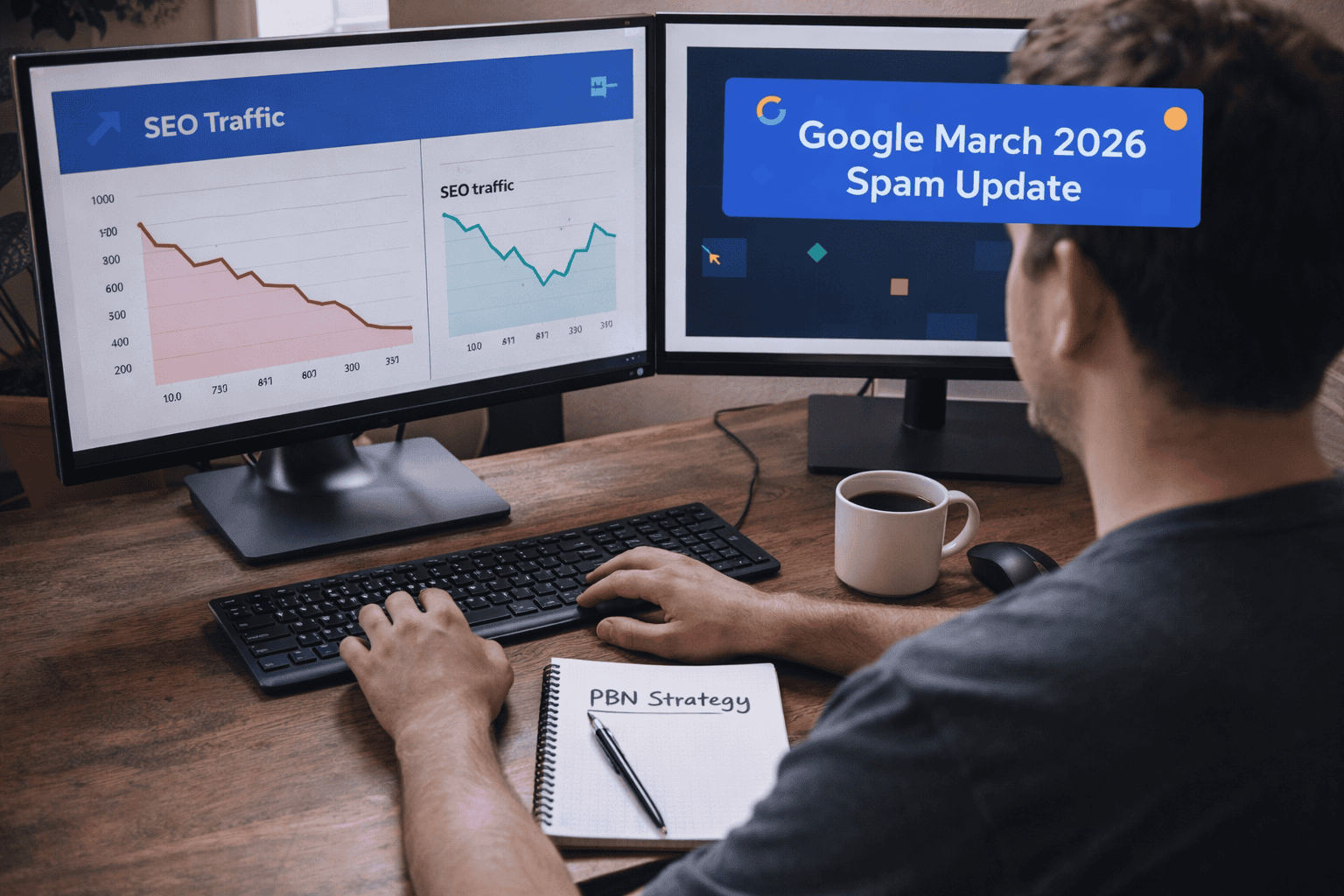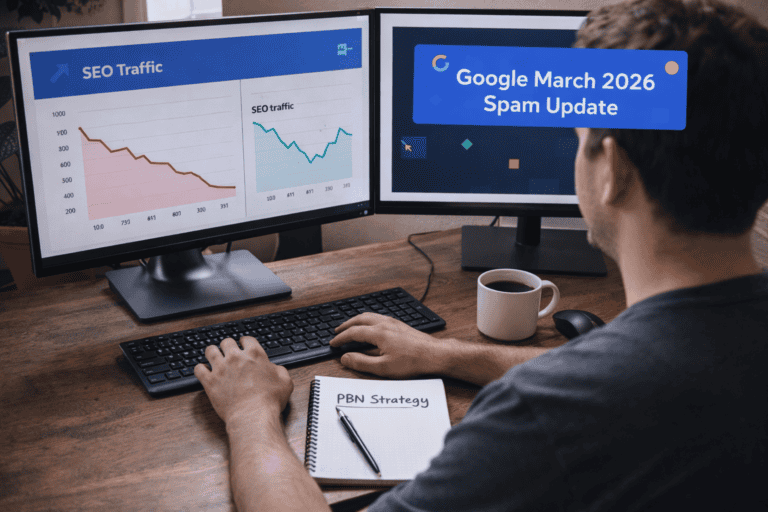
Google’s March 2026 spam update changed how link building works. Google confirmed the update rolled out in about 19.5 hours, making it unusually fast compared with prior releases. That speed is worth paying attention to. The short rollout suggests Google can deploy spam updates quickly, so site owners should monitor traffic and rankings closely during release windows.
If backlinks still drive your rankings, you’re not alone. The approach has shifted. Cheap links no longer hold up, and relevance and source quality now decide what works. The margin for error is smaller than it’s ever been.
Keep reading to see how this fight is being won on the ground, and what it means for choosing a safe provider and building links in a volatile era.
Key statistics on Google’s March 2026 spam update
Google’s March 2026 spam update landed fast and hit hard. It tightened link enforcement and pushed low-quality tactics further out of play. At the same time, demand for backlinks hasn’t dropped, it’s just shifted toward relevance and credibility.
- <20 hours rollout – one the fastest confirmed spam update so far
- Global impact – the same rules apply across all regions and languages
- Shortest update window – compared to 7 days (Dec 2024) and 27 days (Aug 2025)
- SpamBrain upgrade – stronger detection of link spam and network patterns
- 85.8% effectiveness – digital PR professionals who rate backlinks as their top tactic
- Two-thirds priority – Over two-thirds of professionals rate relevance as the main factor in link quality
- 68.2% shift – believe link-building works better now than a year ago
- 53% of traffic – around 53% of website traffic still comes from organic search
- $786B+ market – projected size of digital marketing in 2026
- 85.1% measurement – success tracked by quality links earned
Backlinks still matter. That hasn’t changed. What has changed is how easy it is to fake them. Google is better at spotting patterns, and weaker setups don’t hold up for long.
<20 hours rollout: the fastest spam update on record
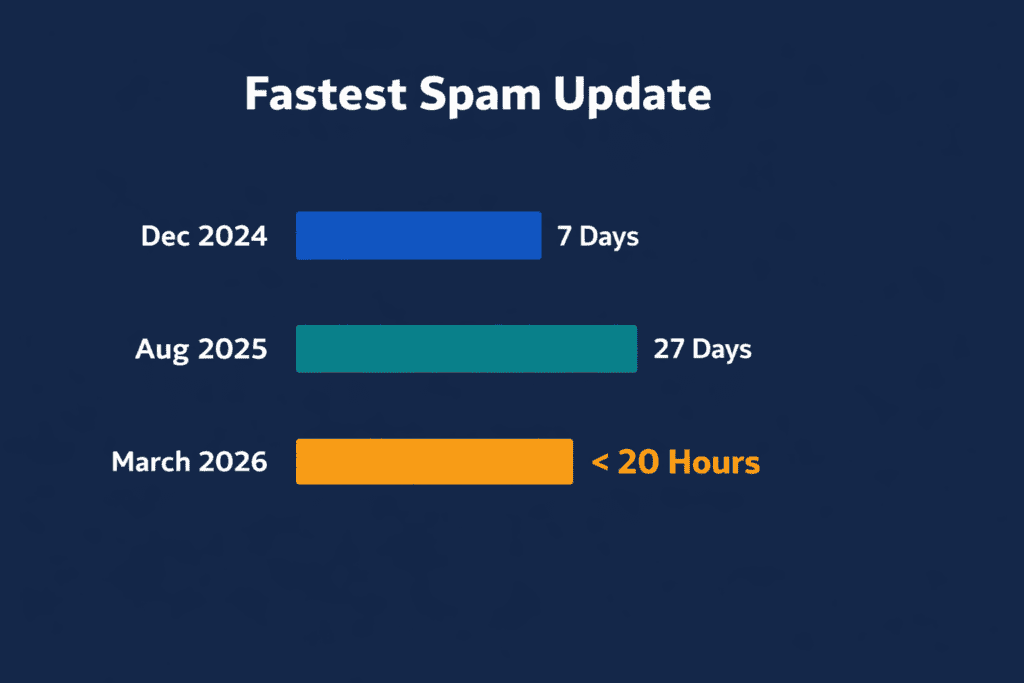
The March 2026 update finished in under 20 hours. That’s unusually quick. Earlier updates took days or even weeks to fully roll out.
According to the Google Search Status Dashboard, it wrapped up between 12:00 PM PT on March 24 and 7:30 AM PT on March 25.
To put this in perspective, earlier updates took far longer. A quick comparison of recent rollouts:
| Update Date | Rollout Duration |
| December 2024 | 7 days |
| August 2025 | ~27 days |
| March 2026 | Under 20 hours |
This speed is what stands out. It represents a significant shift in how Google operates. Updates move fast now. Outdated tactics break quickly, and there’s little time to react. The short rollout suggests Google can deploy spam updates almost instantly when they find systemic abuse.
Global Application: No Safe Zones for Link Spam
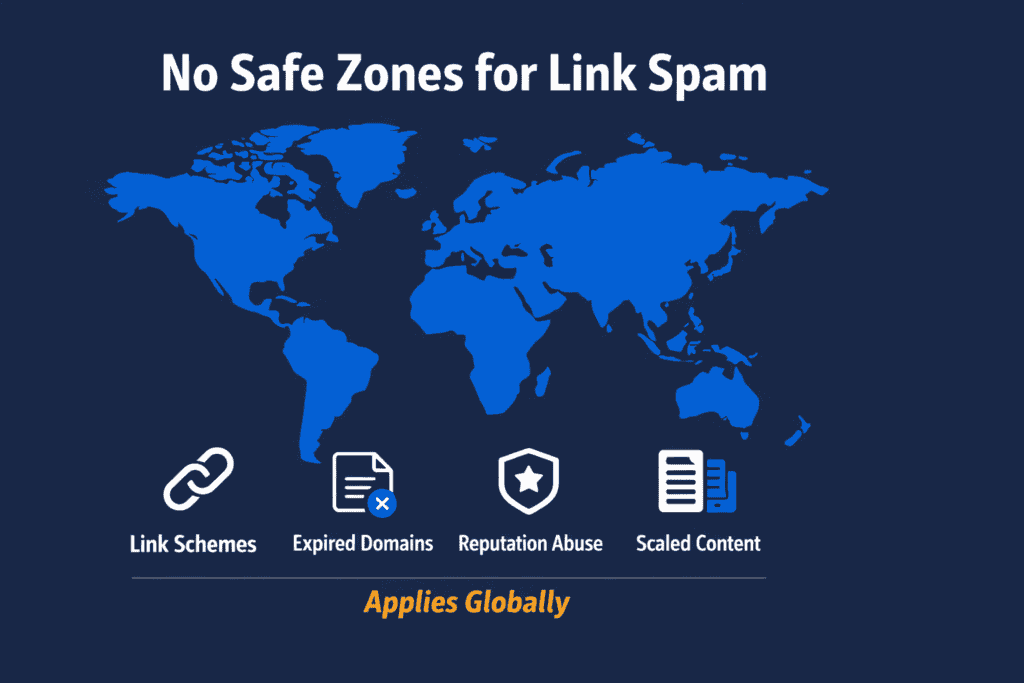
The update applies globally and to all languages, according to Search Engine Journal. It reinforced existing spam policies from Google Search Central, leaving no localized niches untouched.
The focus areas included:
- Link schemes and manipulative link building
- Expired domain abuse
- Site reputation manipulation
- Scaled content abuse
This isn’t just a localized algorithmic shift, it’s a structural crackdown. When a policy applies globally, there are no “safe niches” or regional loopholes. The bottom line: link quality matters more than link quantity, everywhere.
Improving SpamBrain: AI-Powered Detection in 2026
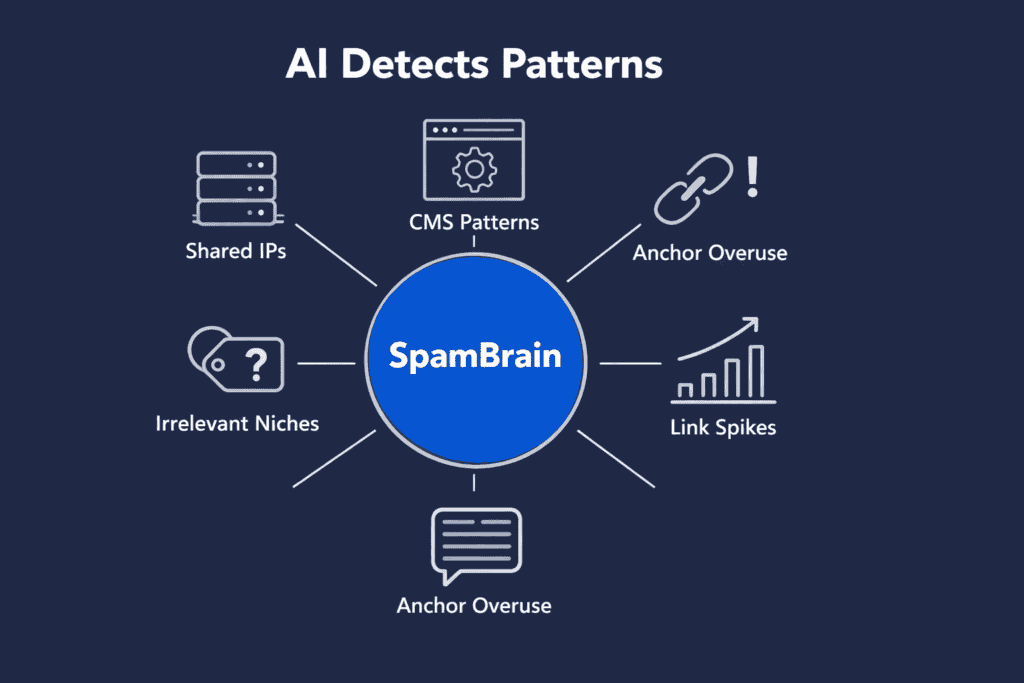
The update specifically improves Google’s SpamBrain system, as summarized by Syntactics, Inc.. SpamBrain uses AI to identify patterns in links, PBN networks, and backlink behavior. In 2026, it operates at scale and catches signals that would have slipped through before.
It doesn’t evaluate links individually. It looks at the full picture, including:
- Shared hosting and repeated IP ranges
- Similar CMS setups across many sites
- Overused anchor text
- Sudden spikes in link growth
- Links between unrelated niches
This is exactly where cheap PBN setups fall apart. They reuse the same infrastructure and scale too aggressively. What worked a few years ago now gets quietly ignored.
53% of Website Traffic: The SEO Stakes
With organic search driving roughly 53% of all website traffic, according to SEOLHR, the stakes for surviving a spam update have never been higher.
Because organic traffic forms the majority of online visibility, losing rankings due to poor link choices can devastate a business. The focus now is precision. Bulk links don’t hold up. Each site needs to meet real quality standards.
If you discuss PBNs at all, frame them as a high-risk tactic rather than a recommended strategy. Google focuses on devaluation rather than manual penalties, meaning rankings often slide without any warning message in Search Console.
87.2% Rate Relevance as the Top Criterion
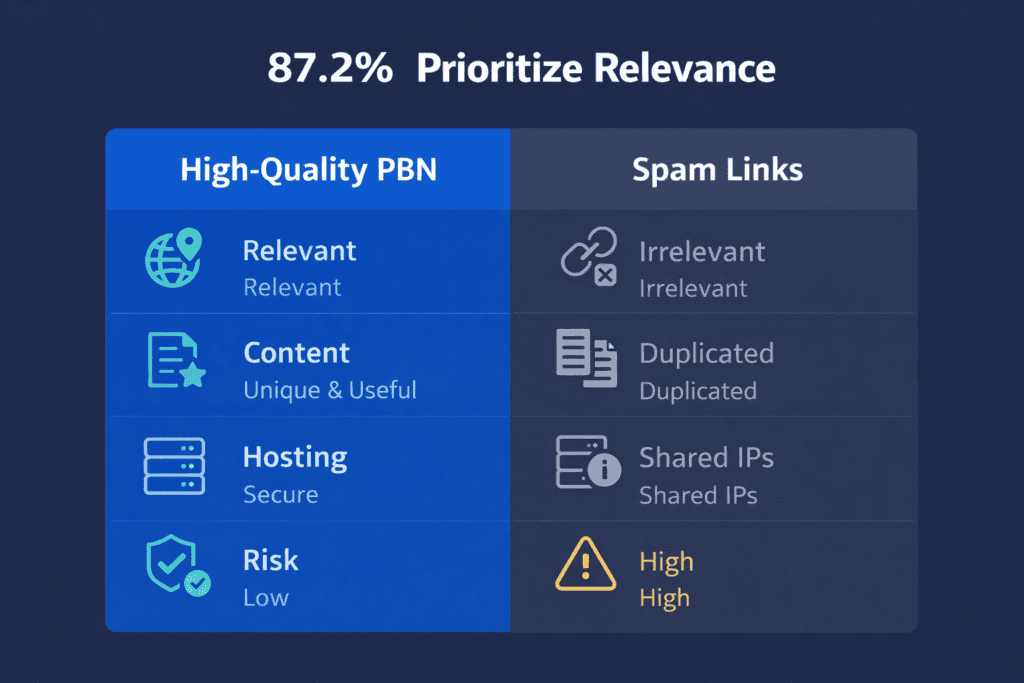
Relevance consistently appears as the top signal of link quality, with 87.2% of professionals citing site relevance as their primary evaluation criterion, according to Motive PR.
This perfectly illustrates the gap between PBN links and spam links. PBN links are controlled backlinks that can work if they’re relevant and well-built. Spam links are low-value, automated, or off-topic.
| Factor | High-Quality PBN | Spam Links |
| Relevance | High | Low |
| Content | Unique, editorial | Thin or AI-generated |
| Hosting | Diversified | Shared footprints |
| Detection Risk | Medium | High |
Relevance decides whether a link carries any weight. If a link was placed purely to move rankings and lacks topical alignment, SpamBrain is increasingly good at recognizing that.
85.8% Agree: Backlinks Are the Most Effective Tactic
Despite the risks, 85.8% of digital PR professionals say building backlinks remains the most effective tactic, according to BuzzStream.
The idea that backlinking is dead isn’t accurate. What stopped working is sloppy execution. Some SEOs continue to experiment with PBNs, though Google’s spam policies explicitly list repurposed expired domains as violations.
High-performing network setups focus on:
- Niche-relevant domains with clean link histories
- Content that reads like genuine editorial work
- Natural posting patterns
85.1% Measure Success by Quality Links
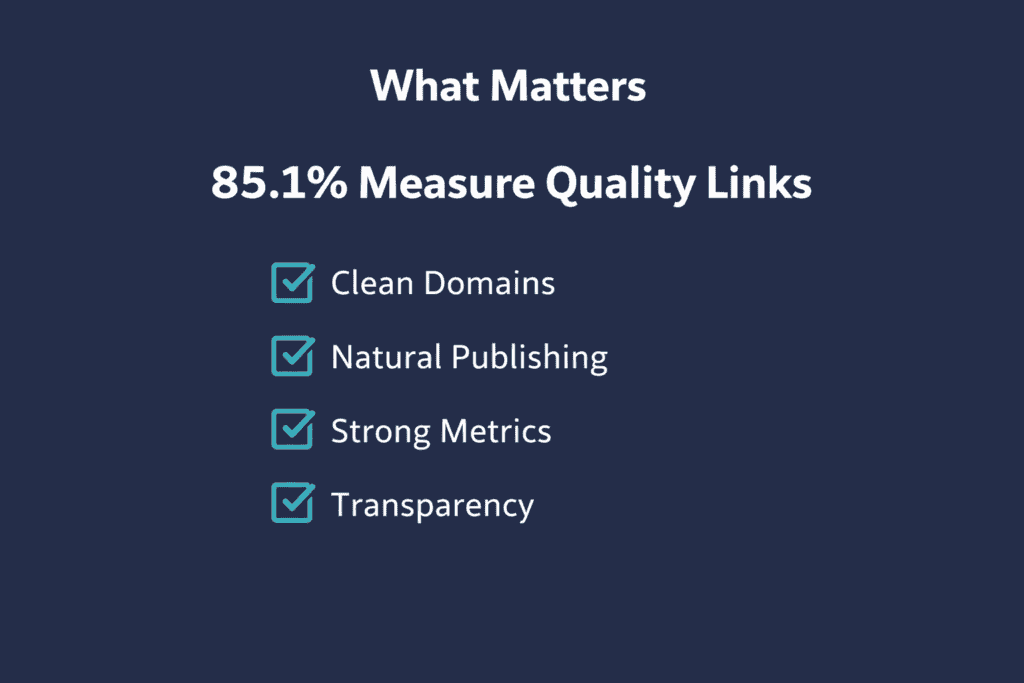
A massive 85.1% of professionals measure success primarily by the number of quality links earned, according to BuzzStream.
This metric shifts the focus toward choosing the right providers. The best providers prioritize quality, relevance, and clean execution. Price and volume matter less than they used to.
What to look for in a provider:
- Strong domain metrics (DA, DR, TF)
- Clean backlink profiles with no spam signals
- Natural publishing schedules
- Hosting spread across different providers and IPs
Good providers are also transparent. You should be able to understand how and where links are placed. If the details are vague, that’s a red flag.
68.2% Find Link Strategies More Effective Now
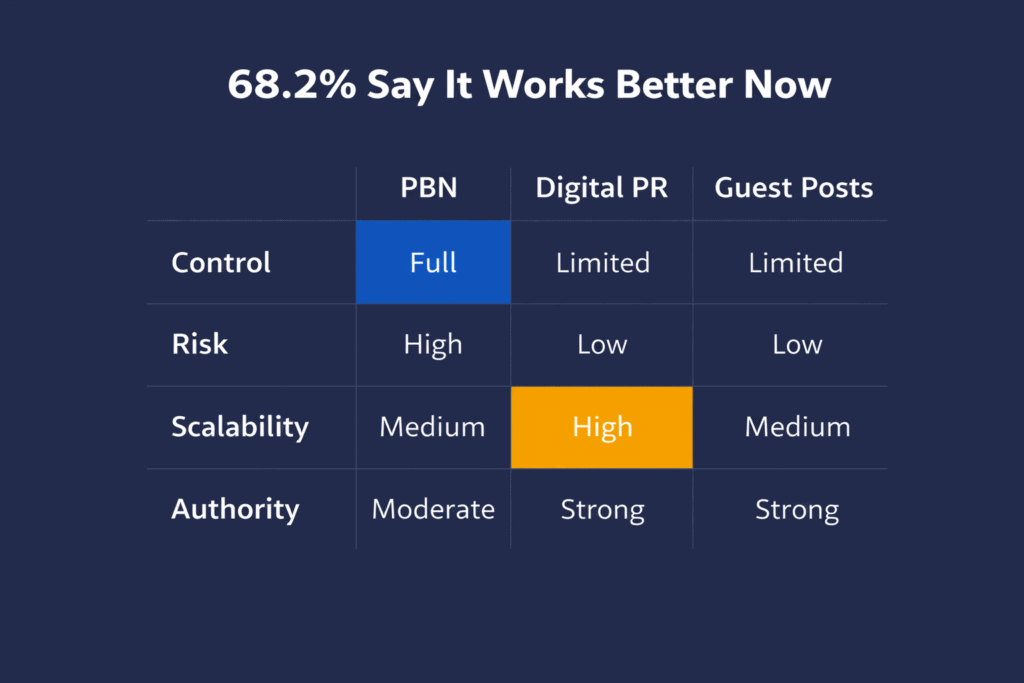
Surprisingly, 68.2% believe that digital PR and link building are more effective now than they were 12 months ago, according to Motive PR.
This is largely because algorithm updates clear out the noise, rewarding those who execute well. A mixed approach holds up better over time, blending PBNs, digital PR, and guest posts.
| Strategy | Control | Risk | Scalability | Authority |
| PBN | High | Medium | High | Medium |
| Digital PR | Low | Low | Medium | High |
| Guest Posts | Medium | Low | Medium | Medium |
Relying on one method creates a single point of failure. A balanced mix spreads that risk, utilizing PBNs for targeted, niche-specific links and digital PR for strong authority signals.
$786+ Billion Industry: Protecting Your Network

With the global digital marketing industry projected to reach $786+ billion in 2026 according to SEOLHR, protecting your backlink investments is critical.
The main risks are footprint detection, irrelevant domains, aggressive anchor text, and poor-quality providers. These lead to links losing value, or, in serious cases, manual penalties.
Key risks include:
- Shared hosting patterns across multiple PBN sites
- Expired domains with bad backlink histories
- Overuse of exact-match anchor text
- Thin or duplicated content
One weak link rarely causes damage alone. Patterns do. That’s why the provider matters, a poorly built network leaves clear traces that threaten your slice of this massive industry.
Footprint Avoidance: Safe Hosting in 2026
Avoiding footprints comes down to variation. Hosting, site structure, and ownership signals all need to differ across your network. SpamBrain reviews infrastructure, not just links, which makes technical setup matter.
Best practices:
- Use multiple hosting providers
- Assign a unique IP to each domain
- Register domains through different registrars
- Use different CMS themes and plugin configurations
These steps reduce the chance of network-wide detection. Footprint control isn’t about complexity, it’s about not repeating yourself. Patterns are what detection systems catch first.
What Anchor Text and Link Velocity Work Safely?
Safe links rely on natural anchor text and steady, gradual link growth. The goal is to mirror how links appear on real websites. Google tracks how backlinks accumulate over time. Sharp spikes or repetitive anchor patterns get noticed quickly.
A balanced anchor profile includes:
- Mostly branded anchors
- Some partial-match anchors
- Very few exact-match anchors
- Links added slowly over weeks or months
When links get devalued, they don’t disappear, they just stop passing value. That’s why restraint matters more than volume.
How to Audit and Recover from PBN-Related Penalties
Recovery starts with a full backlink audit. The goal is to identify harmful links, remove them where possible, and rebuild a cleaner profile.
Steps to follow:
- Use a backlink auditing tool to review your profile
- Flag low-quality or irrelevant domains
- Request link removals where possible
- Submit a disavow file to Google
Recovery takes time, weeks to months before rankings stabilize. Trust rebuilds slowly. A mix of strong links from diverse sources helps. Many SEO teams now combine targeted placements with editorial links to stabilize results over time.
FAQ
How can I choose a safe PBN provider without risking penalties?
Choose a provider that clearly explains how they manage IP diversity, IP allocation, and server location across multiple data centers. They should avoid shared IPs and reduce hosting footprints through proper footprint minimization. Ask about server patterns and configuration patterns. A reliable setup reduces link manipulation signals and lowers the risk of detection by Google’s SpamBrain algorithm. Note: No PBN setup is completely ‘safe’ under Google’s current spam policies.
What hosting setup works best for PBN networks?
A balanced setup often works best. Providers may use VPS hosting, bulk buy hosting, or unmanaged hosts, while others offer managed options. The focus should be on clean IP addresses across different IP classes, including Class A, B, or C IP ranges. Proper server setup, DDoS protection, and intrusion protection are more important than choosing the cheapest option.
How important are content and CMS diversity in a PBN?
Content diversity plays a major role in keeping a network natural. Relying only on AI-generated content can increase risk under Google’s SpamBrain. A mix of writing styles works better. CMS diversity and CMS variation also help reduce patterns. If using WordPress hosting, rotate WordPress themes and WordPress plugins while maintaining WordPress compatibility for stable site management.
What security features should a PBN provider include?
A strong provider includes SSL certificates such as Let’s Encrypt SSL and other security services. They should protect against online attacks, including malformed data and SQL command injections. Features like automatic backups, intrusion protection, and network health monitoring help prevent issues that could lead to deindexed pages or loss of control over the network.
How do I evaluate PBN performance and SEO value?
Evaluate performance using SEO metrics such as DA check, TF check, and index and TF check tools. An indexation checker helps confirm that pages remain indexed. Site speed, server location, and content delivery networks also affect performance. Focus on consistent indexation and natural backlink acquisition instead of short-term gains that weaken long-term SEO stability.
Stricter Rules, Smaller Margin, Smarter Moves
Rankings drop faster now, and weak links stop working almost overnight. Systems like SpamBrain are built to detect patterns, not just links, which means shortcuts break quickly.
Arch SEO focuses on relevance-first link building with clean infrastructure and controlled execution, so your rankings don’t rely on tactics that stop working after the next update.
See how a safer link strategy is built.
References
- https://status.search.google.com/incidents/VbnSXAH4SmEcxPtx4YSD
- https://www.searchenginejournal.com/google-begins-rolling-out-the-march-2026-spam-update/570428/
- https://www.syntacticsinc.com/news-articles-cat/google-spam-update-march-2026/
- https://www.buzzstream.com/blog/state-of-digital-pr-2026/
- https://www.motivepr.co.uk/blog/digital-pr-statistics-2026
- https://seo-lhr.com/agency/digital-marketing-statistics-2026/